Planogram Compliance: How to Run Visual Merchandising Audits with Photo Proof
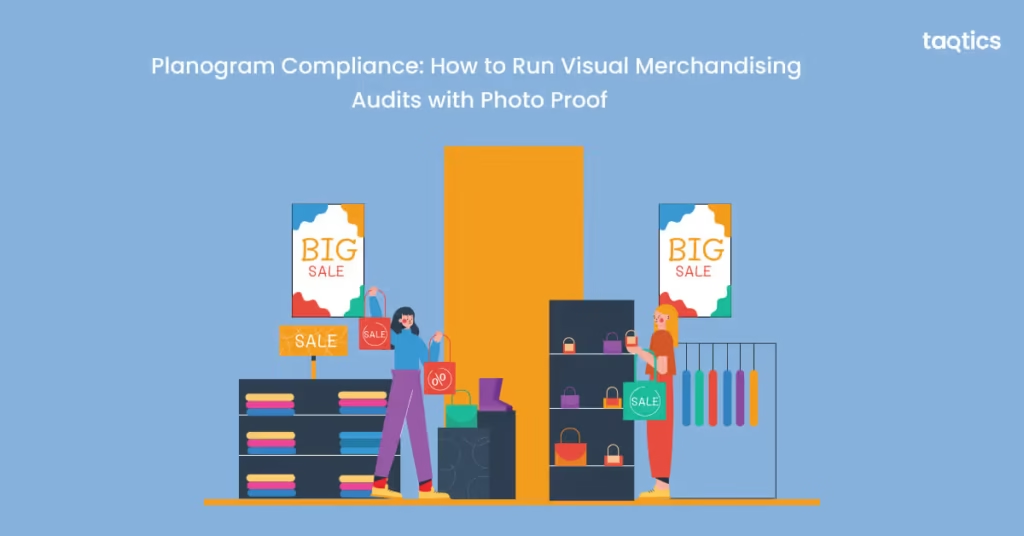
Planogram compliance is the process of ensuring that every product on retail shelves is displayed exactly according to the approved layout, maintaining consistency across stores to boost visibility, sales, and customer experience. Planogram compliance has a direct impact on retail performance, according to a Trax Retail Execution Report (2018), improving shelf execution accuracy can increase same-store sales by up to 9.2%, while NielsenIQ (2020) found that nearly 60% of retail execution issues stem from poor shelf compliance. These figures highlight how crucial a well-executed planogram strategy is to reducing stockouts and strengthening brand presence.
Running visual merchandising audits with photo proof takes compliance tracking to a new level of precision and transparency. Industry data from Infilect (2024) and the National Association of Retail Marketing (2023) indicate that planograms can fall out of compliance by 10% each week without consistent monitoring, and over 50% of CPG and retail teams struggle to verify shelf layouts manually. By integrating photo-based audits, supported by AI image recognition and guided workflows, retailers can objectively verify compliance, accelerate corrective actions, and ensure that their visual merchandising strategy translates seamlessly from plan to in-store reality.
What Is Planogram Compliance?
Planogram compliance refers to how closely in-store product displays follow the approved planogram, a layout that defines the ideal placement, facing, and shelf order of products. It ensures uniform presentation across stores, improving brand consistency and customer experience. According to POPAI’s Shopper Engagement Study (2021), 76% of purchase decisions occur in-store, showing how effective shelf organization influences buying behavior. A compliant shelf makes products easier to find, enhances visibility, and builds brand trust.
The key benefits of maintaining planogram compliance include:
- Consistent brand presentation across locations
- Optimized visibility and product accessibility
- Reduced stockouts and better shelf accuracy
- Higher sales conversions
- Actionable merchandising insights
For both retailers and CPG brands, compliance drives measurable gains. Retailers benefit from improved stock turnover and category performance, while CPG brands secure stronger shelf share. The NielsenIQ Retail Execution Benchmark Report (2022) found that non-compliance can lead to 20% sales loss from misplaced products, and Harvard Business Review (2020) reported that consistent merchandising execution significantly boosts category growth.
What Are Common Challenges With Planogram Compliance In Stores?
Common challenges with planogram compliance in stores often stem from inconsistent execution, manual errors, and limited oversight. Issues like inconsistent store layouts, manual auditing errors, lack of visibility for HQ teams, time-consuming audits, misplaced SKUs, and planogram drift over time can significantly affect sales and brand consistency.
- Inconsistent store layouts: Variations in store size, fixtures, and local product assortments make it difficult to apply a universal planogram. Kantar Retail (2021) notes that over 40% of retailers adjust layouts locally, often compromising visual uniformity and brand standards.
- Manual auditing errors: Traditional pen-and-paper or spreadsheet-based audits often result in human error and incomplete data. Accenture’s Retail Report (2022) found that manual processes can miss up to 18% of non-compliance instances, reducing the accuracy of store-level insights.
- Lack of visibility for HQ teams: Central teams struggle to verify compliance without real-time photo or digital proof. FMI’s Retail Execution Study (2023) revealed that 58% of brands lack end-to-end visibility into in-store execution, delaying corrective actions.
- Time-consuming audits: Manual compliance checks consume staff hours that could be used for customer service or sales. According to Deloitte’s Retail Operations Study (2021), a full-store audit can take 4–6 hours on average, adding labor costs without ensuring accuracy.
- Misplaced SKUs and poor staff execution: Limited training or unclear instructions can lead to misplaced items, breaking planogram integrity. NielsenIQ (2022) reported that misplaced SKUs account for 15% of on-shelf availability issues, directly impacting shopper experience.
- Planogram drift over time: Even after initial setup, shelves gradually fall out of alignment due to restocking habits or unmonitored changes. IRI Worldwide (2023) found that compliance can decline by 10% every two weeks without consistent monitoring.
Studies by McKinsey & Company (2022) and Retail Dive (2023) indicate that execution gaps between planned and actual shelf layouts can reach 25–30%, leading to reduced category performance and shopper dissatisfaction.
What Is A Planogram Compliance Software?
A planogram compliance software is a digital solution that automates the monitoring and verification of in-store product displays to ensure they match the approved planogram layouts. It addresses key aspects like digital planogram creation, image capture, AI-powered analysis, automated compliance checks, reporting and insights, and actionable task management.
How It Works
- Digital planogram creation: Retailers or CPG brands create a digital blueprint that outlines the ideal shelf arrangement, facings, and category flow.
- Image capture: Store teams or field representatives take photos of actual shelves using mobile devices, uploading them to the centralized software.
- AI-powered analysis: Using AI and computer vision, the software detects SKUs, shelf gaps, and misplaced items in real time.
- Automated compliance check: The system automatically compares actual shelf images with digital layouts to pinpoint non-compliance and missing items.
- Reporting and insights: Provides detailed visual reports on compliance levels, pricing accuracy, stock conditions, and promotional display execution.
- Actionable tasks: Users can assign corrective actions to store teams, monitor completion, and ensure accountability at every stage.
A study by Capgemini Research Institute (2023) revealed that AI-led shelf auditing can reduce human error by over 25%, making it one of the most reliable methods for visual merchandising verification.
Key Benefits
- Increased sales: Ensures best-selling products remain well-positioned and visible, improving turnover rates.
- Reduced stockouts: Identifies empty shelves early to prevent lost sales.
- Faster audits: Speeds up compliance checks — PwC’s Retail Operations Study (2022) found that digital audits are 4x faster than manual ones.
- Improved consistency: Maintains uniform shelf presentation and brand experience across multiple locations.
- Data-driven decisions: Generate real-time insights to optimize shelf space and product mix.
- Enhanced accountability: Provides a transparent system for tracking and resolving execution errors at the store level, strengthening overall operational discipline.
According to IDC’s Retail Merchandising Analytics Report (2024), businesses using automated compliance systems experience up to 30% improvement in planogram accuracy and 20% faster issue resolution compared to traditional auditing methods.
How Do You Choose The Right Planogram Compliance Software?
You can choose the right planogram compliance software by evaluating how well the platform aligns with your retail operations, team workflows, and merchandising goals. The ideal solution should combine AI-driven automation, easy mobility, and integration with existing retail tools to ensure seamless execution.
- Mobile accessibility: Ensure the software offers a responsive mobile app that allows store staff and field reps to capture shelf images, complete audits, and receive updates on the go. Gartner (2023) found that mobile-enabled audits improve reporting efficiency by 35% due to real-time uploads.
- Integration with retail execution tools: The system should integrate with ERP, CRM, and retail execution platforms for unified data sharing and improved decision-making. This allows both HQ and in-store teams to align on compliance metrics, product availability, and promotional performance.
- Custom audit templates: Look for software that supports customizable audit templates to fit different store formats, product categories, and campaign types. Flexible templates reduce training time and ensure consistency across multiple retail environments.
- AI-photo audit functionality: Advanced solutions use AI and computer vision to automatically detect non-compliance from shelf images. Capgemini Retail Research (2023) reports that AI-photo audits can reduce manual inspection time by up to 60%, improving accuracy and response speed.
- Offline capabilities for field reps: In regions with weak internet connectivity, offline access ensures field reps can capture photos and complete audits without disruption, syncing data once the connection is restored.
- Compare vs. manual compliance methods: Manual compliance checks rely heavily on human observation, which leads to subjectivity and errors. Automated tools, by contrast, provide objective, data-backed insights. Retail Systems Journal (2024) noted that stores switching from manual to automated compliance saw 15% fewer out-of-stocks and a 9% sales lift within six months.
Top use cases
Planogram compliance software is widely adopted across:
- CPG brands – to verify product visibility and promotional display accuracy.
- Grocery retail – to maintain category layouts and reduce stockouts in fast-moving SKUs.
- Big-box retailers – to standardize merchandising across hundreds of stores.
- Pharmaceutical and beauty retail – to ensure adherence to regulated product placements.
According to Forrester’s Retail Execution Technology Report (2024), retailers that adopt integrated compliance software achieve 22% higher audit accuracy and 30% faster shelf correction times compared to those using manual methods.
How Do Visual Merchandising Audits Ensure Planogram Compliance?
Visual merchandising audits ensure planogram compliance by systematically verifying that store shelves, displays, and promotional layouts align with the approved planogram and brand standards. These audits bridge the gap between planned visual merchandising and actual in-store execution, ensuring consistency, visibility, and optimal product placement.
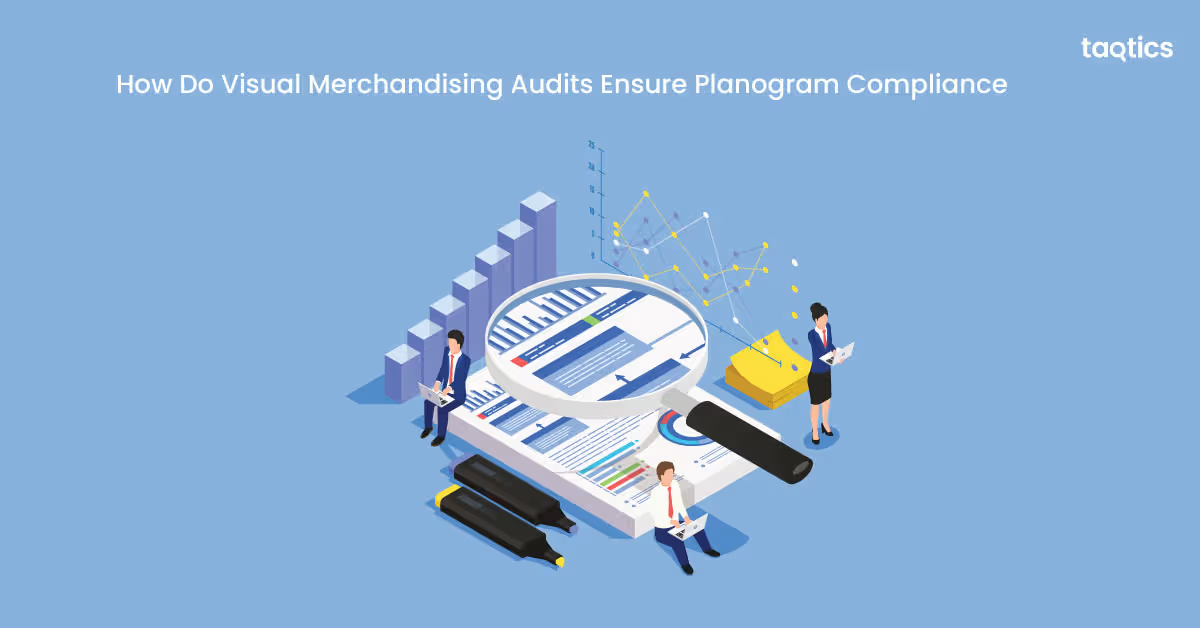
Types of Visual Merchandising Audits:
- Manual audits: Conducted by in-store staff or merchandisers using printed checklists to review product placement and shelf setup. While accessible, they are often subjective and time-consuming.
- Photo-based audits: Store teams or field reps capture images of displays for central review. This approach provides visual proof and allows remote validation by head-office teams.
- Software-driven audits: The most advanced form, using AI and image recognition to analyze shelf photos in real time. Accenture Retail Analytics Study (2024) found these audits can detect non-compliance with over 90% accuracy, reducing manual effort and speeding up corrective actions.
Role of Visual Merchandising Audits in Enforcing Planograms:
- Identify non-compliant displays and misplaced SKUs instantly.
- Provide visual evidence that supports transparent, data-driven decisions.
- Enhance accountability by assigning corrective actions to specific teams.
- Improve training by highlighting recurring execution gaps.
- Boost compliance rates and sales through consistent monitoring and rapid issue resolution.
According to the Retail Insight Merchandising Compliance Report (2023), retailers conducting structured audits achieve up to 30% higher planogram adherence and 15% fewer out-of-stock incidents, resulting in stronger sales performance and customer satisfaction.
What Should Be Included In A Visual Merchandising Audit Checklist?
A visual merchandising audit checklist should include all key elements that ensure a store’s product displays and layouts meet brand, operational, and compliance standards. The essential components are planogram adherence, shelf positioning and facings, price label accuracy, stock levels and out-of-stocks, promo execution, cleanliness and organization, and photo documentation.
- Planogram adherence check: Verify that product placements, facings, and category flow match the approved planogram layout. NielsenIQ (2022) found that precise planogram execution can increase category sales by 7–10% through better shelf visibility.
- Shelf positioning & facings: Ensure products are placed at the correct eye-level and facing the customer. Optimal shelf positioning is proven to boost sales—Shopper Science Journal (2023) reported that eye-level placement increases product visibility by 35% compared to lower shelves.
- Price label accuracy: Confirm that every product has a correct and clearly visible price label. PwC’s Retail Consumer Report (2022) highlighted that pricing errors can cause 19% of shoppers to abandon purchases due to perceived inconsistency.
- Stock levels & out-of-stocks: Assess current inventory levels and note missing SKUs. IRI’s On-Shelf Availability Study (2023) estimated that 8% of retail sales losses stem from out-of-stock products, making this a critical audit parameter.
- Promo execution: Check that promotional displays, offers, and signage are set up according to campaign guidelines. Kantar Retail (2023) found that consistent promotional execution can improve campaign ROI by up to 18%.
- Cleanliness & organization: Evaluate shelf hygiene, clutter, and overall display presentation. Clean and well-organized shelves enhance shopper perception and dwell time, as confirmed by Harvard Business Review (2021).
- Photo documentation: Capture and upload shelf images for visual verification and record-keeping. Gartner’s Retail Audit Technology Report (2024) noted that photo-backed audits improve compliance visibility by 40%, enabling faster remote validation.
According to the FMI Retail Operations Study (2023), stores that use structured audit checklists achieve 28% higher compliance accuracy and 20% faster corrective action rates compared to those without standardized audit frameworks.
How Does Photo Proof Help With Visual Merchandising Audits?
Photo proof helps with visual merchandising audits by providing visual evidence of in-store execution, allowing retailers and brands to validate whether displays, planograms, and promotions are implemented correctly. It combines both manual and automated photo verification methods to ensure transparency, accuracy, and accountability. According to Forrester’s Retail Audit Intelligence Report (2024), the use of photo proof can improve audit accuracy by up to 45% and reduce reporting time by 30%, making it one of the most effective tools for modern retail compliance.
- Manual photo proof: Store teams or field representatives capture photos of displays, shelves, and signage using mobile devices. These images are then reviewed by managers or head-office teams to confirm compliance. Manual photo proof ensures visual validation without relying solely on written reports.
- Automated photo proof: Advanced audit software uses AI and computer vision to automatically analyze captured photos against digital planograms. The system flags non-compliance, such as missing SKUs or incorrect facings – within minutes. Capgemini’s AI in Retail Study (2023) found that automated image analysis can detect shelf errors with 93% accuracy, reducing the need for manual verification.
Benefits of Photo Proof in Visual Merchandising Audits:
- Objective proof: Provides unbiased, verifiable evidence of display conditions, minimizing human interpretation errors.
- Enhanced accountability: Tracks which store or team executed the setup, ensuring responsibility at every level.
- Faster feedback loop: Enables near real-time communication between field reps and HQ for quicker corrections.
- Remote validation: Allows central teams to audit multiple locations without physical visits, saving time and travel costs.
Deloitte’s Retail Transformation Report (2023) highlighted that retailers using photo-based audits saw 20% faster corrective actions and 15% higher compliance consistency compared to those using text-only reports.
Examples of Photo Proof in Practice:
- Before/after photo audits: Capture images before and after planogram adjustments to document improvements.
- Geo-tagged images: Attach location metadata to verify that photos were taken in the correct store.
- Timestamps: Record the exact date and time to ensure audits are recent and authentic.
In conclusion, photo proof transforms visual merchandising audits into a data-backed, transparent, and efficient process. By integrating manual validation with AI-driven automation, retailers and CPG brands can maintain stronger compliance, faster turnaround times, and more consistent in-store execution across every location.
How Can Teams Implement Planogram Audits At Scale Across Stores?
Teams can implement planogram audits at scale across stores by combining well-trained personnel, standardized processes, and technology-driven tools that streamline execution and reporting. The key elements include training field reps and store teams, standardizing audit procedures, leveraging mobile and cloud-based platforms, and tracking KPIs like compliance scores and audit frequency.
- Train field reps / store teams: Start by providing structured training on how to perform audits, capture photo proof, and identify compliance gaps. Retail Council of Global Standards (2023) notes that well-trained field reps contribute to 40% higher first-pass compliance rates, reducing rework and errors.
- Standardize audit processes: Create uniform checklists, templates, and audit criteria for all store formats. This ensures consistency and comparability across locations. NielsenIQ (2023) found that standardized audits can reduce operational variance by up to 20%, improving visibility and reporting accuracy.
- Use mobile apps + cloud-based systems: Equip field teams with mobile audit apps that sync with centralized cloud dashboards. This allows real-time photo uploads, instant feedback, and automated scoring. Forrester Retail Technology Study (2024) highlights that mobile-based audit tools can cut manual reporting time by 50% while improving collaboration between HQ and field teams.
- Set KPIs: compliance score, audit frequency, resolution time: Establish measurable performance metrics to track audit efficiency. KPIs such as overall compliance percentage, average time to resolve issues, and audit turnaround frequency help maintain accountability and continuous improvement.
Process Flow Example
- Schedule: Head office or regional managers schedule audits for specific stores or zones based on frequency (e.g., weekly or monthly) or upcoming promotions.
- Audit: Field reps visit the store with a standardized checklist via mobile app and inspect product placements, shelf facings, and promo displays.
- Capture Photo Proof: Reps take geo-tagged and timestamped photos of the shelves to provide visual documentation for HQ review.
- Review: The software or central team analyzes images—manually or through AI—to identify planogram deviations or missing SKUs.
- Correct: Store teams receive alerts or task assignments for non-compliant areas and implement corrections (e.g., repositioning products or updating signage).
- Re-Audit: After corrections, a follow-up audit or automated photo verification is conducted to confirm compliance.
Scaling planogram audits successfully requires a blend of human expertise and digital intelligence. According to McKinsey’s Retail Productivity Report (2024), retailers that standardize and digitize planogram audits see 35% faster compliance checks and 25% improvement in shelf execution accuracy across multi-store operations.
How often should you audit for planogram compliance?
You should audit for planogram compliance regularly through a structured process to ensure consistent product placement, brand visibility, and sales performance. The ideal frequency depends on store type, product category, and promotional cycles.
- Weekly: For high-traffic stores or fast-moving consumer goods (FMCG) with frequent stock changes.
- Biweekly: For mid-volume retail locations with moderate SKU turnover.
- Monthly: For stores with stable assortments or limited promotional shifts.
- Quarterly or post-promotion: For seasonal audits or after major resets, campaigns, or planogram updates.
Regular auditing ensures quick detection of shelf execution issues and helps maintain brand consistency. As highlighted in the McKinsey Retail Efficiency Report (2024), companies that monitor planogram compliance continuously achieve 25–30% faster corrective action cycles and better in-store performance outcomes.
Who is responsible for ensuring planogram compliance?
People from multiple roles within retail and CPG organizations are responsible for ensuring planogram compliance.
- Merchandising Managers: Design and distribute planograms to ensure visual consistency across all store formats.
- Store Managers: Oversee in-store execution, ensuring displays match corporate guidelines.
- Field Merchandisers / Sales Reps: Conduct audits, capture photo proof, and correct non-compliant setups.
- Category Managers: Align shelf layouts with sales data and consumer demand patterns to optimize performance.
- Corporate / HQ Teams: Use compliance software to monitor execution, track KPIs, and generate performance reports.
According to NielsenIQ’s Retail Performance Report (2023), stores with clearly defined accountability structures see up to 28% higher compliance accuracy than those without formal ownership.
Can photo audits fully replace in-person visits?
No, photo audits cannot fully replace in-person visits. However, they are highly efficient for remote verification, helping teams save time and reduce costs. As per the Forrester Retail Innovation Report (2024), photo audits can speed up compliance checks by 40% and cut costs by 25%.
In-person visits remain essential for assessing complex factors like store ambience, customer behavior, and relationship management. The best approach is a hybrid model, where photo audits handle routine checks and field visits provide deeper, contextual insights.
About the Author