Retail Mystery Shopper Checklist: Definition, Importance & Components

A retail mystery shopper checklist is a structured framework used by companies to assess the performance of their retail operations through secret shoppers who act like ordinary customers. A retail mystery shopper checklist ensures that the evaluation is systematic and comprehensive, covering everything from staff behavior and service quality to store environment and compliance with brand standards.
Imagine a shopper entering a clothing store to buy a shirt. Unbeknownst to the staff, this shopper assesses how quickly they are greeted, whether staff knowledgeably suggest sizes or styles, how clean and organized the store is, whether prices and promotions are properly displayed, and how smoothly checkout proceeds. Based on that visit, the retailer gets a detailed report, identifying strengths, e.g., friendly staff, clean store, and weaknesses, like long wait time at checkout.
This checklist is important because it gives retailers a reliable, on-the-ground view of the customer experience, one that cannot be captured fully through surveys or self-reported data. According to a study published in 2019 in the Journal of the Retail Industry, there may be a low correlation between mystery-shopping assessments and actual customer satisfaction or sales performance, which suggests retailers should treat mystery-shop results as one of several tools rather than a definitive measurement.
Nonetheless, such checklists remain valuable: they help ensure consistent service quality, detect compliance or operational lapses, and indicate where employee training or process improvements are needed for benefits documented across multiple retail and hospitality studies.
Download the checklist. Run it like a system.
Get the ready-to-use template, and see how Taqtics captures photo proof, timestamps, and compliance automatically.
What Is A Retail Mystery Shopper Checklist?
A retail mystery shopper checklist is a structured evaluation tool used by retailers to assess real in-store customer experience through anonymous shoppers who rate specific service and operational factors. It helps capture what actually happens on the shop floor, not what managers assume occurs.
To enhance clarity and readability, the core components typically included in a retail mystery shopper checklist are:
- Staff behaviour and courtesy
- Store cleanliness and ambience
- Product availability and display accuracy
- Speed and quality of service
- Adherence to brand standards and policies
- Checkout efficiency and billing accuracy
- Overall shopping experience and ease of navigation
According to Wilson (1998), mystery shopping is widely adopted because it provides firsthand, behaviour-based insights that traditional surveys often miss. Similarly, a study by Finn & Kayandé (1999) found that mystery shopping is especially useful for identifying service lapses and operational inconsistencies, making it a strong diagnostic tool for retail performance improvement.
What Is a Retail Mystery Shopper and What Do They Do?
A retail mystery shopper is an individual hired by a company to anonymously visit its stores and evaluate the quality of the customer experience, operational efficiency, and adherence to brand standards. This process, known as retail mystery shopping, helps businesses understand how their stores perform from a real customer’s perspective. Mystery shoppers behave like ordinary buyers, interacting with staff, exploring the store, making purchases, and later documenting their experience in a detailed report.
The key roles and responsibilities of a retail mystery shopper:
- Observe how staff greet and interact with customers
- Evaluate store cleanliness, ambience, and overall presentation
- Check product availability, pricing accuracy, and display standards
- Assess service speed and staff knowledge
- Monitor billing accuracy and checkout experience
- Report any compliance issues related to brand policies or processes
- Submit a detailed, structured evaluation after the visit
The purpose of mystery shopping in retail is to provide unbiased, ground-level insights that internal teams may overlook. It helps retailers identify strengths and gaps in customer service, store presentation, compliance, and employee performance. The data collected supports better training, operational improvements, and consistency across locations.
Why Is a Mystery Shopper Checklist Important?
A mystery shopper checklist is important because it helps retailers capture store performance in a consistent and structured way.
- Helps standardize observations: Standardizing what the shopper must observe ensures that each evaluation is comparable across stores and time periods.
- Ensures objective feedback: The checklist also promotes objectivity by directing the shopper to focus on specific behaviors, service steps, and operational details, reducing personal bias and improving the reliability of the feedback.
- Avoids missed steps: Beyond accuracy, the checklist ensures no critical element of the customer journey is overlooked, from greeting to checkout.
- Used for internal training and external compliance: Retailers use the data gathered to identify performance gaps, train staff more effectively, stay compliant with brand and regulatory standards, and maintain consistency across multiple locations.
This checklist is a foundational tool for improving overall customer experience and operational excellence.
What Should Be Included in a Retail Mystery Shopper Checklist?
A mystery shopper checklist must include all the key elements that shape a customer’s journey, ranging from store appearance to staff behavior and the final checkout experience.
Exterior & Interior Appearance
This section evaluates the store’s overall look and feel, beginning from the entrance. It should check whether the parking lot and entrance were clean and free of debris, if signage was clearly visible and undamaged, whether the store layout was organized and tidy, if aisles were free of clutter, and whether fitting rooms or restrooms were clean and well-maintained.
Customer Service
This part captures how effectively staff interacted with the shopper. It should assess whether the customer was acknowledged within a specific timeframe (e.g., 30 seconds), if the greeting was friendly and professional, whether staff offered help and asked relevant questions, how knowledgeable they were, and whether they made an effort to go above and beyond.
Merchandise & Product
To measure product presentation and availability, the checklist must review whether merchandise was arranged neatly, if prices were clear and easy to read, whether desired items were available in the correct size or style, and if perishable goods appeared fresh and within code.
Checkout Process
This section evaluates the smoothness of the billing experience. It should include whether the cashier was friendly and professional, if there were fewer than a specific number of customers in line (e.g., three), how long the transaction took from reaching the counter to receiving the receipt, whether loyalty/rewards programs were mentioned, and if the cashier thanked the shopper at the end.
Overall Experience
The final part captures the shopper’s overall perception of the visit. It should ask about their overall impression of the store and staff, whether they would recommend the business to others, and whether there were any standout features or unique offerings that influenced their experience.
A well-designed retail mystery shopper checklist acts as a powerful benchmarking tool, helping retailers understand exactly what customers experience at every stage of their visit.
What Are the Most Common Mistakes Mystery Shoppers Make?
The most common mistakes mystery shoppers make include forgetting to observe key details, submitting late reports, giving subjective opinions, skipping parts of the checklist, being noticed by staff, and not following client-specific guidelines.
- Forgetting to observe key details: Missing critical aspects of the store or service, such as staff interactions or product placement.
- Submitting late reports: Delays make it harder for retailers to act on findings promptly.
- Giving subjective opinions: Sharing personal impressions rather than factual observations can skew results.
- Skipping parts of the checklist: Leaving sections blank results in incomplete assessments.
- Being noticed by staff: Acting unnaturally can alert employees, affecting their behavior and the authenticity of the evaluation.
- Not following client-specific guidelines: Ignoring instructions or protocols can make the report irrelevant for the retailer’s objectives.
Avoiding these mistakes ensures that mystery shopping remains a reliable tool for internal training and external compliance, providing actionable insights for improving customer experience.
Are There Different Checklists for Different Retail Environments?
There are different checklists for different retail environments, which include: clothing store checklist, grocery or supermarket checklist, electronics store checklist, luxury retail vs budget retail, and other variations by niche.
- Clothing store checklist: Focuses on fitting room cleanliness, helpfulness of staff with sizes and styles, and proper display of seasonal or promotional collections.
- Grocery or supermarket checklist: Evaluates the freshness of produce, accurate labeling, shelf stocking, and speed and friendliness at checkout.
- Electronics store checklist: Emphasizes staff technical knowledge, product demonstrations, and clarity on warranty or service options.
- Luxury retail vs budget retail: Luxury stores are assessed for premium presentation, personalized service, and attention to detail, whereas budget retail focuses on efficiency, pricing clarity, and inventory availability.
- Examples and variations by niche: Checklists can be further customized for specific sectors like pharmacies, home décor, or sporting goods to capture unique operational and customer experience standards.
Tailoring checklists to each retail environment ensures that mystery shopping provides accurate, actionable insights relevant to the type of store and its customers.
What Tools or Apps Can Help With Mystery Shopping Checklists?
The tools or apps that can help with mystery shopping checklists include digital checklists, a real-time data capturing tool, geo-verification, automated reporting, and follow-up tracking.

- Digital checklist templates & mobile apps: Tools can replace manual paper checklists. Shoppers simply fill out standardized forms on a phone or tablet, ensuring consistency and reducing human error.
- Real‑time data capture + media evidence: Apps allow shoppers to take photos or even annotate images (store layout, displays, signage, etc.) alongside checklist responses, so retailers get visual proof rather than just descriptions.
- Offline support & geo‑verification: Some tools support offline data entry (useful if store Wi‑Fi or mobile connectivity is weak) and can use GPS tagging to verify that the shopper was actually at the correct location.
- Automated reporting & analytics dashboards: Once the checklist is completed, the app can automatically generate professional reports, summarize findings, highlight trends or recurring issues across multiple visits or stores, saving time and helping managers make data‑driven decisions.
- Task assignment & follow‑up tracking: If problems are found (e.g., cleanliness issues, non‑compliance, poor service), these tools often let managers assign follow-up tasks, track remediation, and maintain accountability.
Using technology makes it easier to record observations, collect evidence (e.g. photos), and submit reports quickly.
What Should a Mystery Shopper Report Look Like?
A mystery shopper report should look like a clear, structured, and detailed document that communicates the shopper’s observations in a way that is actionable for the retailer. A strong mystery shopper report is organized into sections that cover all key aspects of the store visit.
- Visit Information – Date, time, location, and purpose of the visit.
- Store Appearance – Observations about cleanliness, signage, layout, and overall ambience.
- Customer Service – Evaluation of staff greeting, assistance, knowledge, and professionalism.
- Merchandise & Product – Notes on product availability, pricing, and display quality.
- Checkout Process – Speed, accuracy, and staff friendliness during the transaction.
- Overall Experience – Shopper’s summary impressions, standout moments, and any issues encountered.
Let’s check out the report template
- Header: Store name, address, date/time, shopper ID
- Checklist Responses: Yes/No or rating scales for each observation
- Comments Section: Open-ended notes to describe notable events
- Proof Section: Attach photos of displays, receipts, or other supporting evidence
- Final Score/Rating: Optional scoring based on a predefined rubric
Including photos, receipts, and timestamps in the report strengthens credibility and provides objective evidence for any findings. Detailed notes prevent misinterpretation and allow management to track trends or recurring issues across multiple visits. A comprehensive report ensures that mystery shopping is not just observational but also a valuable tool for improving store operations and customer experience.
A well-prepared report not only captures what happened during the visit but also provides proof to back up the findings, helping management make informed decisions about training, operations, and compliance.
How Do Companies Use Mystery Shopper Checklists?
Companies use mystery shopper checklists for staff training and coaching, benchmarking store performance, compliance and brand standards audits, and improving the overall customer experience.
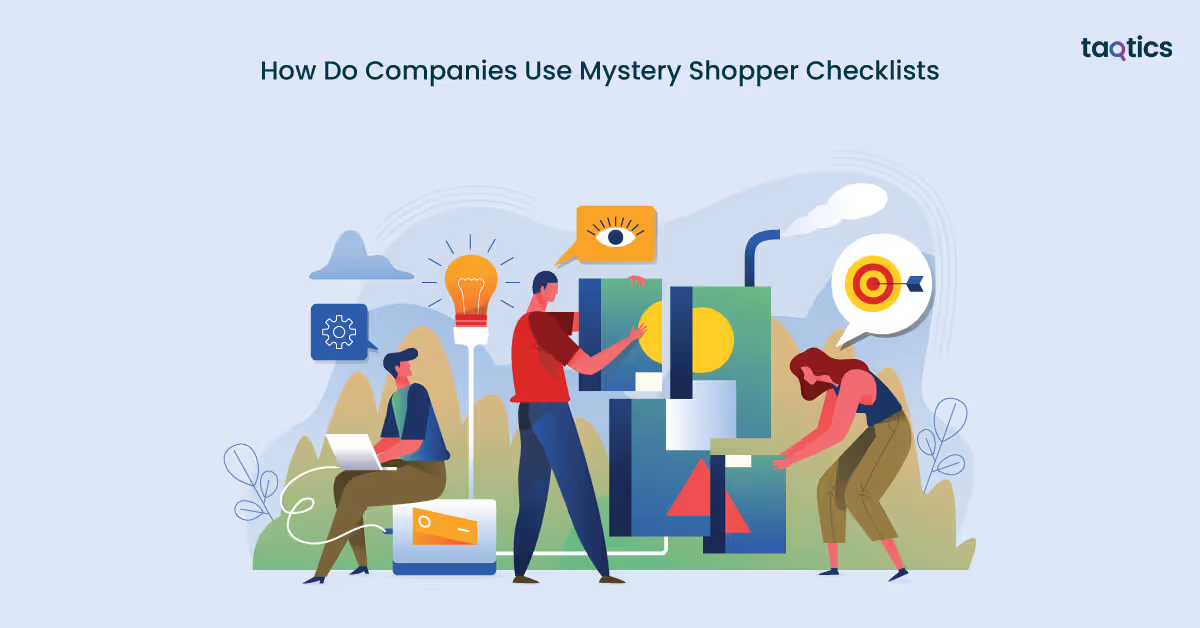
- For staff training and coaching: Checklists identify gaps in employee knowledge, behavior, or service delivery, allowing managers to provide targeted feedback and personalized training.
- To benchmark store performance: By evaluating multiple locations using the same checklist, companies can compare performance across stores, regions, or teams, highlighting both high-performing outlets and those needing improvement.
- Compliance and brand standards audits: Retailers ensure that operational protocols, promotions, and merchandising standards are consistently followed, reducing the risk of errors or brand inconsistency.
- Customer experience improvement: Insights from checklists help enhance the overall shopping experience, from greeting and assistance to checkout efficiency and store environment, ultimately boosting customer satisfaction and loyalty.
By leveraging mystery shopper checklists in these ways, companies turn observational data into a practical tool for improving service quality, operational consistency, and brand reputation.
Download the checklist. Run it like a system.
Get the ready-to-use template, and see how Taqtics captures photo proof, timestamps, and compliance automatically.
How Can I Download a Retail Mystery Shopper Checklist Template?
You can download a retail mystery shopper checklist template from a variety of online sources that provide ready-to-use or customizable formats. These templates are designed to help mystery shoppers systematically evaluate store performance, staff behavior, product presentation, and the overall customer experience.
- Official retailer or auditing platforms – Many companies that offer mystery shopping services provide downloadable templates for their shoppers.
- Audit and inspection software – Tools like GoAudits, Lumiform, or SafetyCulture often include prebuilt retail checklists that can be downloaded and customized.
- Business and retail blogs – Websites that focus on retail management or customer experience frequently offer free or paid checklist templates for download.
- Template repositories – Platforms like Template.net or Scribd provide editable retail checklist templates suitable for mystery shopping assignments.
Once downloaded, you can customize the template to reflect your store type, checklist categories, and client-specific requirements, ensuring it captures all relevant observations during a mystery shopping visit.
About the Author