
Customer Complaint Handling Checklist: Definition, Importance & Components
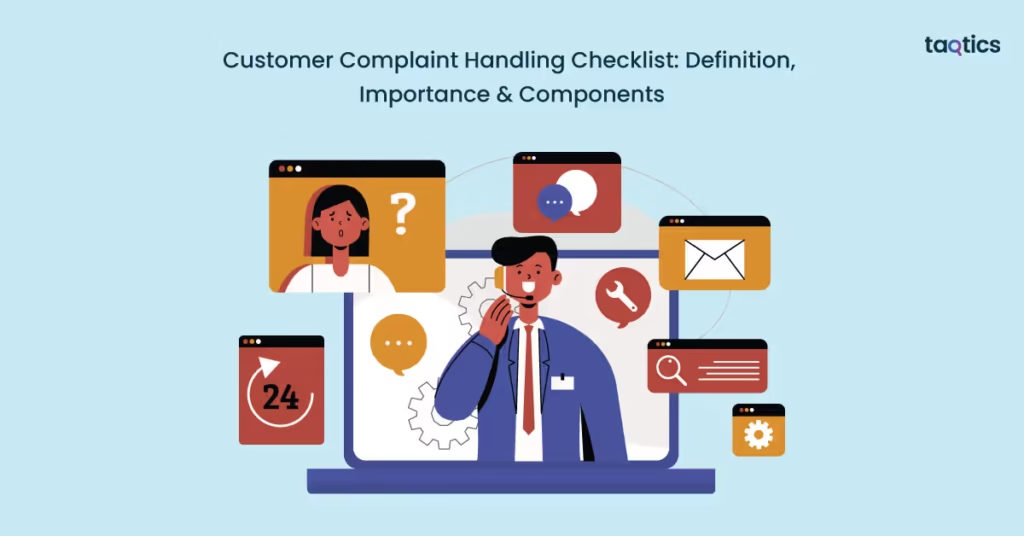
A customer complaint handling checklist is a structured framework that helps businesses systematically manage, track, and resolve customer complaints in a consistent and efficient manner. A customer complaint handling checklist ensures that no critical step, such as acknowledgment, investigation, resolution, and follow-up, is missed, enabling organizations to deliver timely and satisfactory responses to customer concerns.
According to a 2023 report by HubSpot, 93% of customers are likely to make repeat purchases with companies that offer excellent customer service, highlighting the importance of effective complaint handling in building loyalty. Beyond retention, complaint management also directly impacts brand perception and revenue.
What Is a Customer Complaint Handling Checklist?
A customer complaint handling checklist is an operational tool used by organizations to standardize how customer issues are addressed across teams and touchpoints. It provides a clear sequence of actions that staff must follow when dealing with complaints, ensuring accountability and uniformity in responses regardless of who handles the case.
This checklist usually outlines responsibilities, escalation paths, response timelines, and documentation requirements. It helps teams stay organized, maintain transparency, and ensure that every concern is properly tracked until closure. By using such a checklist, businesses can streamline internal processes, minimize errors, and deliver a more reliable and professional customer service experience.
A 2022 study by PwC found that 32% of customers would stop doing business with a brand they love after just one bad experience, emphasizing the need for structured processes to address issues promptly. A well-defined complaint handling checklist not only improves response consistency and accountability but also helps businesses identify recurring issues, enhance service quality, and strengthen long-term customer relationships.
Why Is Customer Complaint Handling Important in Retail?
Customer compliant handling is important in retail because of its impact on brand reputation, customer retention, and overall business performance. The way complaints are managed can influence how customers perceive a brand, whether they return, and what they communicate to others about their experience.
Impact on Brand Reputation
Handling complaints effectively helps maintain and strengthen brand image. Poor complaint resolution can damage trust, while prompt and professional responses can enhance credibility. According to a 2023 report by Zendesk, 73% of customers say they will switch to a competitor after multiple bad experiences.
- Builds trust and credibility when handled well.
- Poor handling leads to negative brand perception and loss of loyalty.
Customer Retention vs Acquisition Cost
Complaint handling is closely linked to customer retention, which is more cost-effective than acquiring new customers. A 2020 Harvard Business Review study states that acquiring a new customer can cost 5 to 25 times more than retaining an existing one.
- Resolving complaints increases repeat purchases and loyalty.
- Ignored complaints result in higher churn and increased acquisition costs.
Word-of-Mouth & Online Reviews
Customer experiences are widely shared through reviews and social media, making complaint handling crucial for public perception. A 2022 BrightLocal study found that 77% of consumers read online reviews for local businesses.
- Positive resolutions can turn dissatisfied customers into advocates.
- Negative experiences can spread quickly and impact potential customers.
Store-Level vs Brand-Level Damage
Unresolved complaints at a single store can escalate and affect the reputation of the entire brand, especially in multi-location retail businesses.
- Local issues can quickly become brand-wide concerns.
- Consistent complaint handling ensures a uniform customer experience across all outlets.
Customer complaint handling is a vital retail function that goes beyond issue resolution. It safeguards brand reputation, improves customer retention, and influences how a business is perceived both offline and online.
What Are The Core Components Of Customer Complaint Handling Checklist?
The core components of the customer complaint handling checklist are initial response and empathy, documentation and assessment, investigation and resolution, and follow-ups and improvement.
Initial Response & Empathy
The first interaction sets the tone for the entire complaint resolution process. A calm, empathetic, and attentive approach helps de-escalate situations and build trust with the customer.
- Listen Fully: Give the customer your undivided attention without interrupting.
- Remain Calm: Stay professional and composed, even if the customer is upset.
- Acknowledge & Validate: Apologize sincerely and show empathy, even if you may not fully agree.
- Thank Them: Appreciate the customer for bringing the issue to your attention.
Documentation & Assessment
Proper documentation ensures that complaints are tracked, analyzed, and resolved efficiently without missing key details.
- Log the Complaint: Record date, customer details, product/service involved, and the issue in a central system.
- Categorize & Prioritize: Assess severity (e.g., critical vs minor) and assign to the relevant department if needed.
Investigation & Resolution
A structured investigation helps identify the root of the problem and ensures fair and effective resolution.
- Gather Facts: Review transaction records, communication history, and relevant product or service data.
- Propose a Solution: Offer appropriate resolutions such as refund, replacement, or store credit based on policy.
- Communicate Clearly: Inform the customer about actions being taken and provide a realistic resolution timeline.
Follow-Up & Improvement
The process does not end with resolution; follow-up ensures satisfaction and helps prevent future issues.
- Confirm Satisfaction: Follow up with the customer to ensure the issue has been resolved satisfactorily.
- Root Cause Analysis: Identify underlying reasons for the complaint to avoid recurrence.
- Continuous Improvement: Regularly review complaint trends to improve staff training and internal processes.
Incorporating these core components not only improves customer satisfaction and trust but also helps organizations identify gaps, enhance processes, and deliver a consistently better customer experience over time.
What Are the Most Common Customer Complaints in Retail Stores?
The most common customer complaints in retail are rude staff behavior, long billing queues, out-of-stock items, pricing mismatch, product quality issues, return/refund delays, poor store cleanliness, and warranty disputes.
- Rude staff behavior: Customers often complain about unhelpful, inattentive, or impolite staff, which can quickly damage the shopping experience and discourage repeat visits.
- Long billing queues: Extended waiting times at checkout counters lead to frustration, especially during peak hours, and may even result in abandoned purchases.
- Out-of-stock items: Customers feel disappointed when desired products are unavailable, particularly if inventory information is unclear or not updated.
- Pricing mismatch: Differences between displayed prices and billing prices can create distrust and dissatisfaction, making customers question store transparency.
- Product quality issues: Complaints arise when products do not meet expectations in terms of durability, fit, or performance, leading to returns or negative feedback.
- Return/refund delays: Slow or complicated return and refund processes frustrate customers and reduce confidence in the store’s service policies.
- Poor store cleanliness: Unclean floors, trial rooms, or shelves negatively impact the overall shopping environment and brand perception.
- Warranty disputes: Lack of clarity or support in honoring warranties can lead to conflicts and dissatisfaction, especially for high-value purchases.
Addressing these common complaints proactively helps retailers enhance customer experience, build trust, and improve long-term loyalty while reducing negative feedback and operational inefficiencies.
How Can Technology Improve Customer Complaint Management?
Technology can improve customer complaint management through centralized complaint dashboard, real-time insights, and streamlined processes that help businesses respond faster and more effectively.
- Centralized complaint dashboards: Technology enables all customer complaints to be captured and managed in a single platform, making it easier for teams to track status, assign responsibilities, and ensure timely resolution without missing any cases.
- Real-time analytics: Businesses can monitor complaints as they occur, identify urgent issues, and take immediate action. Real-time visibility helps reduce response time and improve overall service efficiency.
- Root cause identification: Advanced systems analyze recurring complaints to identify underlying issues, helping retailers address problems at the source rather than just resolving individual cases.
- Multi-store visibility: For retail chains, technology provides a unified view of complaints across all locations, ensuring consistency in handling and helping management compare store performance.
- Trend reports: Automated reporting highlights patterns in customer complaints over time, enabling better planning, staff training, and process improvements.
Platforms like Taqtics help standardize store audits, track service-related issues, and link complaint logging directly with task management systems, ensuring that every complaint is assigned, monitored, and resolved within defined timelines, improving accountability across teams.
What Are the Best Practices for Handling Angry Customers in Retail?
The best practices for handling angry customers in retail include avoiding defensive language, using de-escalation techniques, knowing when to involve security, and offering appropriate compensation when needed.
- Avoid defensive language: Staff should remain calm and avoid arguing or justifying mistakes. Using neutral and respectful language helps prevent the situation from escalating further and shows professionalism.
- Use de-escalation techniques: Listening actively, maintaining a calm tone, and acknowledging the customer’s feelings can diffuse tension. Simple actions like giving the customer space to speak and responding with empathy can significantly reduce anger.
- Know when to involve security: If a situation becomes aggressive or threatens the safety of staff or other customers, it is important to involve security or management immediately. Safety should always be the top priority.
- Offer compensation when appropriate: Providing solutions such as refunds, replacements, discounts, or store credits can help resolve the issue and restore customer trust when justified by the situation.
Staff who can recognize, understand, and manage emotions, both their own and the customer’s, are more effective at resolving conflicts. Additionally, the concept of the service recovery paradox suggests that when a complaint is handled exceptionally well, customers may become even more loyal than if no issue had occurred at all.
What Metrics Should Retailers Track for Complaint Management?
The metrics that retailers should track for complaint management include first response time, resolution time, customer satisfaction (CSAT), Net Promoter Score (NPS), repeat complaint rate, and store-wise complaint ratio.
- First Response Time: This measures how quickly a business acknowledges a customer complaint. Faster responses show attentiveness and help reduce customer frustration at the initial stage.
- Resolution Time: This tracks the total time taken to fully resolve a complaint. Shorter resolution times indicate efficient processes and better coordination among teams.
- Customer Satisfaction (CSAT): CSAT scores reflect how satisfied customers are with the resolution provided. It is usually measured through post-resolution feedback or surveys.
- Net Promoter Score (NPS): NPS indicates customer loyalty by measuring how likely customers are to recommend the brand after their complaint experience. It provides insight into long-term relationship impact.
- Repeat Complaint Rate: This metric shows how often the same issue is reported again, indicating unresolved root causes or gaps in service quality. Lower repeat rates reflect effective problem resolution.
- Store-wise Complaint Ratio: This compares the number of complaints across different store locations, helping identify underperforming outlets and areas that need improvement.
Tracking these metrics enables retailers to move beyond reactive complaint handling and adopt a data-driven approach. By continuously monitoring performance, businesses can improve response times, enhance service quality, and deliver a more consistent and satisfying customer experience.
What Are Examples of Customer Complaint Handling in Retail?
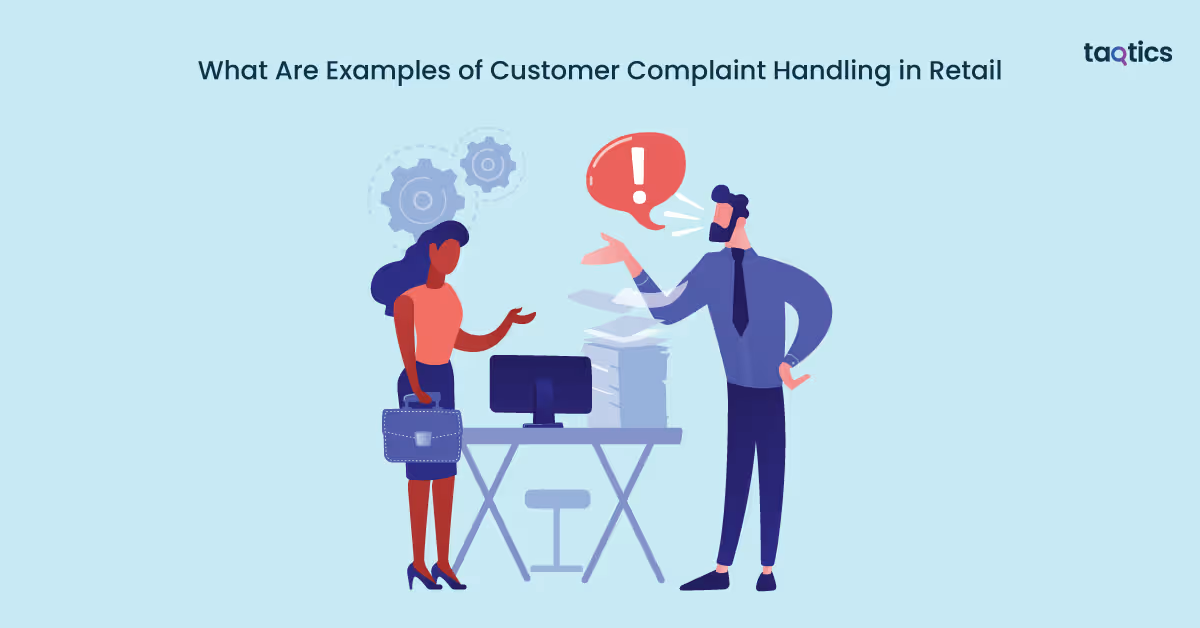
The examples of customer complaint handling in retail include billing disputes, damaged product return, staff misbehavior complaints, and out-of-stock escalation.
- Billing dispute: A customer notices an incorrect charge at checkout and raises a complaint. The staff verifies the bill against pricing and system records to identify the discrepancy. Once confirmed, the issue is resolved by correcting the bill and issuing a refund or adjustment immediately. To prevent such errors in the future, the store conducts regular price audits and ensures POS systems are updated and accurate.
- Damaged product return: A customer reports receiving a damaged product after purchase. The staff inspects the item and validates the purchase details before proceeding. The complaint is resolved by offering a replacement, refund, or store credit as per store policy. To avoid recurrence, the retailer strengthens quality checks and improves handling and storage processes.
- Staff misbehavior complaint: A customer complains about rude or unprofessional staff behavior during their visit. The management listens carefully, gathers details, and reviews the incident with the concerned employee. The situation is resolved through a formal apology and appropriate corrective action or training. Preventive steps include reinforcing staff training programs and emphasizing customer service standards.
- Out-of-stock escalation: A customer is unable to find a desired product in-store and expresses dissatisfaction. The staff checks inventory availability across other stores or warehouses to find a solution. The issue is resolved by arranging a product transfer, reservation, or home delivery if possible. To prevent such situations, the retailer improves inventory planning, stock monitoring, and demand forecasting.
These examples demonstrate how a structured and proactive approach to complaint handling helps retailers resolve issues efficiently, enhance customer satisfaction, and continuously improve store operations.
What Mistakes Should Retailers Avoid When Handling Complaints?
The mistakes that retailers should avoid when handling complaints are ignoring complaints, blaming customers, delaying follow-ups, inconsistent policies, and a lack of proper documentation.
- Ignoring complaints: Failing to acknowledge or respond to customer concerns makes customers feel undervalued and frustrated. Ignored complaints often escalate into negative reviews or loss of loyalty.
- Blaming customers: Holding customers responsible for issues or arguing with them can worsen the situation. It creates conflict and damages the relationship instead of resolving the concern professionally.
- Delayed follow-ups: Taking too long to respond or resolve complaints increases dissatisfaction and may lead customers to switch to competitors. Timely communication is critical to maintaining trust.
- Inconsistent policies: Handling similar complaints differently across stores or situations creates confusion and perceptions of unfair treatment. Consistency is key to maintaining credibility.
- No documentation: Not recording complaints properly leads to missed follow-ups, repeated issues, and a lack of accountability. Documentation is essential for tracking, analysis, and continuous improvement.
Avoiding these common mistakes helps retailers handle complaints more effectively, improve customer satisfaction, and build stronger, long-term relationships with their customers.
About the Author