
Cycle Count Checklist: Definition, Components, Methods & KPIs
A cycle count checklist ensures that selected inventory items are counted regularly to maintain ongoing accuracy without disrupting store operations. A cycle count checklist also helps retailers verify stock levels, identify discrepancies early, and keep inventory records aligned with physical counts. According to a 2023 Zebra Technologies Warehouse Vision Study, nearly 62% of retailers report inventory accuracy as a top operational challenge, making continuous verification methods like cycle counting essential.
A cycle count checklist plays a key role in strengthening inventory control, reducing shrinkage, and improving replenishment decisions. The 2022 MHI Annual Industry Report noted that organizations implementing structured cycle counting programs can improve inventory accuracy by up to 30%, leading to better stock availability and fewer stockouts. By including components such as SKU selection, count methods, variance checks, and performance KPIs, a well-designed checklist helps retailers maintain reliable inventory data and efficient store operations.
What Is Cycle Count Checklist?
A cycle count checklist is a structured guide used to perform routine counts of selected inventory items on a rotating schedule to ensure stock accuracy and proper recordkeeping. Instead of counting the entire inventory at once, it focuses on specific SKUs, categories, or locations at regular intervals to detect discrepancies and maintain control over stock.
This checklist typically outlines steps such as selecting items for counting, verifying quantities in storage and on shelves, recording differences, investigating variances, and updating inventory systems. It ensures that counting is done consistently and that any mismatches are documented and resolved promptly.
By using a cycle count checklist, retailers can maintain accurate inventory records, reduce the risk of stockouts or overstocking, and improve confidence in stock data used for replenishment, planning, and reporting.
What Are The Core Components Of Cycle Count Checklist?
The core components of a cycle count checklist include structured preparation before counting, accurate counting procedures, and proper reconciliation after counting.
Pre-Count Preparation
This stage ensures that the counting process is planned properly and that the environment is ready for accurate verification. Proper preparation reduces confusion, prevents double counting, and improves overall efficiency.
- Define the scope and schedule by selecting categories, zones, or SKUs to be counted and ensuring all items are covered periodically, with high-value items counted more frequently.
- Freeze transactions such as receiving, transfers, or shipping in the area being counted to avoid in-transit errors.
- Assign trained staff who are familiar with the products and storage layout to improve counting accuracy.
- Prepare documentation or mobile scanners with SKU lists and count sheets.
- Organize shelves and storage areas so products are clearly labeled and accessible for counting.
Counting Process
This stage focuses on physically verifying stock and documenting accurate quantities. A structured counting approach ensures reliable results and quick detection of discrepancies.
- Conduct blind counts where staff do not see the expected system quantities to ensure unbiased counting.
- Physically locate and count all items, including backstock, display units, and under-shelf storage areas.
- Record SKU details, product descriptions, locations, and exact quantities counted.
- Note any damaged, expired, or defective items separately.
- Recount immediately if the physical count differs from system records to confirm discrepancies.
Post-Count Reconciliation and Review
This stage ensures that discrepancies are resolved and records are updated accurately. Proper follow-up helps improve inventory processes and prevents recurring errors.
- Investigate variances by identifying root causes such as mislabeling, theft, or unrecorded transactions.
- Update the POS or inventory system to match verified physical counts after approval.
- Analyze discrepancy trends to identify process gaps and improve future counts.
- Resume normal transactions and stock movements once counting and reconciliation are complete.
Covering each of these stages ensures that cycle counts are consistent, accurate, and useful for improving overall inventory control.
Why Do Retailers Use Cycle Counts Instead Of Full Stock Takes?
Retailers use cycle counts instead of full stock takes because the former are less disruptive to store operations and enable faster detection of inventory discrepancies. By counting smaller sections regularly, retailers can maintain accurate inventory without shutting down sales or store activities.
- Less operational disruption: Cycle counts can be conducted during normal store hours on selected SKUs or zones, avoiding the need for full-store closures or major workflow interruptions required for complete stock takes.
- Faster discrepancy detection: Frequent counting of smaller inventory segments helps identify errors, shrinkage, or misplacement quickly, allowing corrective action before discrepancies grow larger.
- Fewer out-of-stock situations: Early detection and correction of inventory errors ensure that stock records remain accurate, reducing unexpected shelf gaps and improving product availability.
- Better replenishment accuracy: Reliable inventory data from regular counts helps teams replenish shelves and reorder stock based on actual availability rather than incorrect system records.
- Improved demand planning: Accurate and up-to-date inventory information supports more precise forecasting and purchasing decisions, reducing both overstock and understock.
Using cycle counts helps retailers maintain continuous inventory accuracy, improve operational efficiency, and support better sales and planning outcomes without the disruption of frequent full stock audits.
How Often Should You Do Cycle Counts?
Cycle counts should be conducted regularly, but the exact frequency depends on product value, sales velocity, and shrinkage risk.
- Adopt the ABC counting method: Categorize inventory into A (high-value/high-movement), B (moderate), and C (low-value/slow-moving) items so counting frequency can be aligned with business impact.
- Count A items most frequently: Fast-moving, high-value, or high-shrink items should be counted weekly or bi-weekly to detect discrepancies quickly and protect sales.
- Schedule monthly counts for B items: Core or mid-value categories can be counted once a month to maintain overall accuracy without excessive workload.
- Count C items less frequently: Slow-moving or low-value items can be counted quarterly or semi-annually, as they pose lower financial and operational risk.
- Adjust frequency based on store performance: Increase counting frequency if shrinkage rises, discrepancies increase, or during peak seasons when stock movement is high.
- Use practical store-level planning: For example, an apparel store may count top-selling styles weekly, core merchandise monthly, and clearance stock quarterly to balance effort and accuracy.
Following a structured cycle count schedule helps retailers maintain reliable inventory records, improve replenishment decisions, and reduce stock-related errors.
What Are The Different Cycle Counting Methods?
The different cycle counting methods include ABC analysis, location-based counting, random sampling, opportunity counting, and control group counting.
ABC analysis-based counting
Inventory is categorized into A, B, and C items based on value and movement. High-value or fast-moving A items are counted most frequently, while lower-value C items are counted less often to balance effort and impact.
Location-based counting (zone or aisle)
Counts are scheduled by physical location, such as aisles, shelves, or backroom zones. This method ensures systematic coverage of the entire store or warehouse over time.
Random sampling
Random SKUs are selected for counting to test overall inventory accuracy. It works well for spotting hidden discrepancies but can miss recurring issues if not combined with other methods.
Opportunity counting
Items are counted during routine activities such as picking, receiving, replenishment, or handling returns. This integrates counting into daily operations and helps maintain continuous accuracy.
Control group counting
Problematic or high-risk SKUs are counted repeatedly to monitor discrepancies and confirm whether corrective actions are working.
Using a combination of these methods helps retailers maintain consistent inventory accuracy, detect discrepancies early, and improve overall stock control without disrupting store operations.
What Cycle Counting KPIs Should You Track?
The cycle counting KPIs you should track include inventory accuracy, variance trends, productivity metrics, and discrepancy resolution time.
- Inventory accuracy (%): Measures how closely system-recorded inventory matches physical counts and is calculated as the percentage of items counted without discrepancies.
- Variance rate: Tracks the percentage of counted lines that show differences between physical and system quantities, helping identify the overall level of inventory mismatch.
- Top variance SKUs (Pareto analysis): Identifies the small group of SKUs causing the majority of discrepancies so teams can focus on high-impact problem items first.
- Adjustment value by reason code: Measures the financial value of inventory adjustments categorized by reason such as damage, theft, or miscounts, helping pinpoint root causes of losses.
- Count productivity (lines per hour): Evaluates how efficiently staff complete counts by tracking the number of SKUs or lines counted per hour.
- Recount rate: Indicates how often items must be recounted due to discrepancies or errors, reflecting the quality and accuracy of initial counts.
- Age of discrepancies or time to resolve: Measures how long it takes to investigate and close inventory variances, ensuring issues are addressed promptly.
Tracking these KPIs helps retailers improve cycle count accuracy, strengthen accountability, and maintain reliable inventory records across stores.
What Variance Threshold Should Trigger A Recount Or Manager Approval?
The variance threshold that should trigger a recount or manager approval depends on the size and value of the discrepancy, but most retailers follow a tiered response to ensure accuracy and control.
- Small variance: Minor quantity differences should trigger an immediate recount once to confirm whether the discrepancy is due to counting error or a genuine mismatch.
- Medium variance: Moderate discrepancies should require a recount followed by basic investigation, such as checking recent sales, transfers, or receiving records to identify the cause.
- Large variance: Significant differences in quantity or value should prompt locking the location or SKU, conducting a full investigation, and obtaining manager or finance approval before making system adjustments.
- High-value SKU variance (any size): Even small discrepancies in high-value items should require supervisor review and documented approval before adjustments are posted.
- Repeated variance patterns: If the same SKU or location shows frequent mismatches, escalate for deeper process review and tighter controls regardless of variance size.
Establishing clear variance thresholds ensures faster resolution, stronger internal controls, and more accurate inventory records across retail operations.
What Are The Most Common Cycle Count Mistakes?
The most common cycle count mistakes include process gaps, labeling issues, and timing errors that create discrepancies between physical and system inventory. These mistakes reduce count accuracy and increase the need for repeated recounts.
- Counting while stock is moving: Conducting counts during active receiving, transfers, or sales can lead to mismatches because inventory levels are changing during the count.
- Unit of Measure (UOM) confusion: Mixing up units such as “each” versus “case” can result in major quantity errors if the system and physical count are not aligned.
- Mixed bins or unlabeled locations: Storing multiple SKUs in the same bin or failing to label locations properly increases the risk of counting the wrong items.
- Returns not processed in the system: When returned items are physically present but not yet recorded (or vice versa), counts will not match system data.
- Receiving posted late: Delays in updating received shipments into the system create temporary discrepancies during cycle counts.
- Phantom inventory due to mis-slots: Items stored in incorrect locations or mis-slotted in the system may appear available in records but cannot be physically found during counting.
Avoiding these common mistakes by freezing movements, standardizing units of measure, labeling clearly, and ensuring timely system updates helps improve cycle count accuracy and overall inventory reliability.
How Do You Investigate Inventory Discrepancies After A Cycle Count?
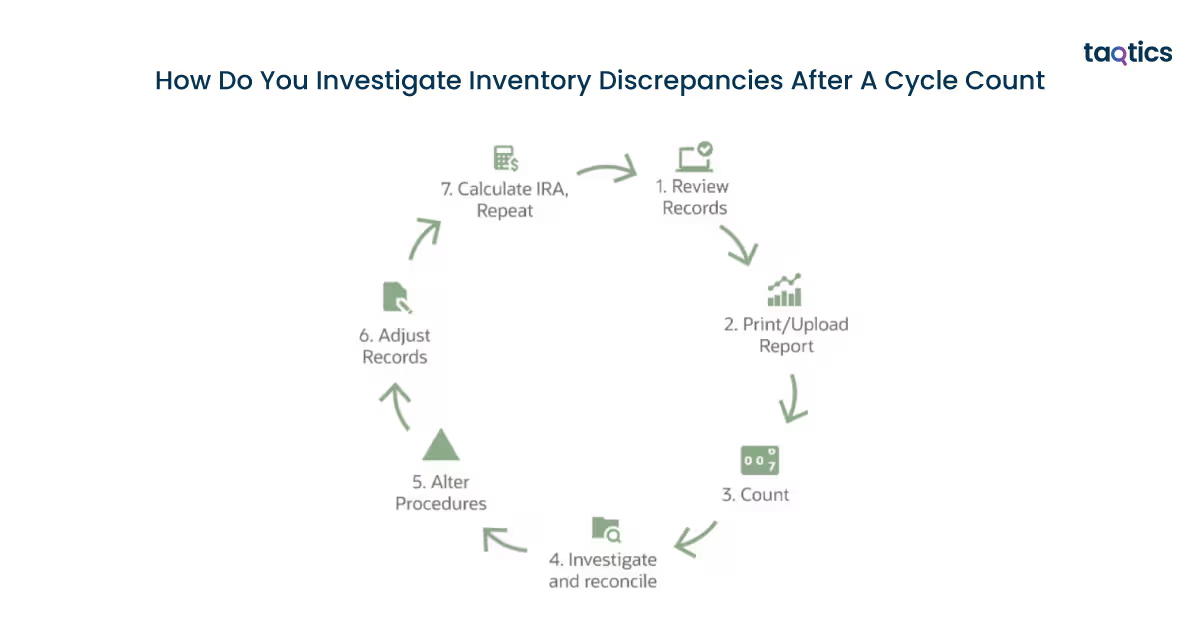
You investigate inventory discrepancies after a cycle count by following a structured, root-cause mindset rather than simply adjusting the numbers in the system.
- Review recent stock movements: Check sales transactions, adjustments, transfers, and returns to see if the discrepancy resulted from unrecorded or delayed activity.
- Conduct a location audit: Physically inspect nearby bins, shelves, and backroom areas to identify mis-slotted or misplaced items that may have been stored incorrectly.
- Validate unit of measure (UOM) and barcode setup: Confirm that the item is being counted in the correct unit (each vs case) and that barcodes are properly mapped in the system to avoid quantity mismatches.
- Examine receiving, picking, and transfer logs: Review documentation and system records to detect posting delays, scanning errors, or incomplete transfer entries.
- Assess shrinkage and damage factors: Check for theft, spoilage, breakage, or unprocessed damaged goods that may not have been recorded properly.
- Analyze recurring patterns: Identify if the same SKU, location, or department shows repeated discrepancies, indicating a process or training issue.
By focusing on identifying the root cause rather than only correcting the variance, retailers can strengthen controls, improve process discipline, and reduce future inventory discrepancies.
How Can Taqtics Help You Run Cycle Counts Consistently Across Stores?
Taqtics can help you run cycle counts consistently across stores by standardizing processes, improving accountability, and providing real-time visibility into inventory verification activities. As a retail operations management software, it enables retailers to execute cycle counting in a structured and uniform way across locations.
- Standardized SOP checklists across stores: Taqtics allows retailers to create and deploy uniform cycle count checklists by store or region, ensuring every team follows the same counting and reconciliation process.
- Task assignment and accountability tracking: Cycle count tasks can be assigned to specific staff members with clear responsibilities, making it easy to track who performed the count and who reviewed or approved it.
- Photo and notes capture for discrepancies: Teams can upload photos and add notes for variances, misplaced stock, or bin issues, providing clear evidence for investigation and resolution.
- Built-in audit trails for compliance: Every count, adjustment, and approval is logged digitally, creating a transparent audit trail that supports internal controls and compliance requirements.
- Dashboards for monitoring and insights: Managers can track completion status, discrepancy trends, and recurring issues across stores through centralized dashboards, enabling faster corrective actions.
By digitizing cycle count workflows and providing real-time visibility, Taqtics helps retailers maintain consistent execution, improve inventory accuracy, and strengthen control across multiple store locations.
What’s The Best Time To Do Cycle Counts In A Retail Store?
The best time to do cycle counts in a retail store is during periods when inventory movement is minimal and operations are stable.
- During low footfall hours: Conduct cycle counts early in the morning before opening, late at night after closing, or during slow traffic windows to avoid interruptions and stock movement.
- After receiving cutoffs: Perform counts once all inbound shipments for the day have been processed and posted in the system to prevent in-transit or unrecorded inventory errors.
- Before major replenishment runs: Counting before scheduled shelf replenishment ensures that system records are accurate and prevents incorrect stock movements based on outdated quantities.
- Avoid peak sales periods: High-traffic hours increase the likelihood of miscounts due to active selling and product handling.
- For multi-location retailers, use a rotating calendar: Schedule different stores or zones on specific days to balance workload, ensure consistent coverage, and maintain ongoing accuracy across locations.
Selecting the right time window for cycle counts helps retailers reduce counting errors, maintain accurate records, and minimize disruption to daily operations.
About the Author