How to Improve Restaurant Operations Management?

Improving restaurant operations means making everyday execution more consistent, efficient, and easier to manage across people, food, service, equipment, and compliance.
The biggest gains usually come from standardizing recurring routines, improving staff capability, reducing inventory and waste issues, strengthening food-safety controls, fixing operational bottlenecks, and making follow-up more visible.
This guide covers practical ways to improve restaurant operations across front-of-house, back-of-house, and multi-location teams.
For a complete explanation of how restaurant operations management works, see our Restaurant Operations Management Guide.
9 Practical Ways to Improve Restaurant Operations
Restaurant operations improve when teams know what has to happen, when it has to happen, who owns it, what the expected standard looks like, and what should happen when that standard is missed.
Standardize Daily Execution Across Every Restaurant
Turn recurring opening, closing, cleaning, food-safety, prep, and manager routines into assigned digital workflows with clear ownership and visibility.
1. Standardize Daily Restaurant Routines
A restaurant becomes harder to manage when opening, closing, cleaning, preparation, handovers, and manager reviews depend on memory or individual habits.
Start by documenting the recurring activities that materially affect service, food quality, food safety, cleanliness, stock availability, customer experience, cash control, and shift readiness. Separate them by operating stage so teams only see the work relevant to the current shift.
- opening readiness;
- kitchen and prep-station setup;
- receiving and stock checks;
- food-safety and hygiene routines;
- front-of-house readiness;
- service-period checks;
- cleaning and sanitation;
- closing and handover.
Each routine should define the owner, timing, expected standard, and proof required. For ready-to-use operating templates, see the Restaurant Checklist Library.
2. Improve Staff Training and Role Clarity
Well-trained staff are essential to smooth restaurant operations. Employees need to understand both their role and the standard they are expected to meet during each shift.
Define responsibilities separately for hosts, servers, kitchen teams, supervisors, managers, cleaners, maintenance teams, and other roles. Training should be role-specific rather than identical for every employee.
- use structured onboarding for new employees;
- train teams on SOPs and service standards;
- use short refreshers when processes change;
- make role ownership clear for every recurring task;
- coach teams when the same execution gap repeats;
- maintain shift coverage and attendance visibility.
For role-based learning and SOP distribution, see Training Management System. For attendance visibility across locations, see Attendance Management Software.
3. Strengthen Inventory, Receiving and Waste Control
Inventory problems are often operational problems before they become system problems. A stock platform may show quantities, but restaurant teams still need disciplined routines for receiving, storage, rotation, availability, waste, and stockroom control.
Improve the process by standardizing:
- receiving quantity and quality checks;
- supplier delivery verification;
- expiry-date checks;
- FIFO or FEFO rotation;
- temperature and storage-condition checks;
- separation of raw and ready-to-eat products;
- damaged-product reporting;
- waste recording;
- stock discrepancy follow-up.
These controls help reduce avoidable waste, improve product availability, and make physical restaurant execution more consistent with the data held in inventory systems.
4. Improve Food Quality and Food-Safety Execution
Food quality and food safety are connected but different. Food quality focuses on whether the product consistently meets the expected standard. Food safety focuses on controlling hazards and maintaining safe handling, storage, sanitation, temperature, allergen, and hygiene practices.
Food quality controls should cover:
- recipe adherence;
- taste and texture;
- portion size;
- presentation;
- freshness;
- ingredient quality;
- packaging and delivery quality.
Food-safety controls should cover:
- personal hygiene;
- temperature control;
- storage;
- allergen handling;
- cross-contamination prevention;
- cleaning and sanitation;
- traceability and records;
- corrective action for failed controls.
For broader quality workflows, see Food Quality Management Software. For structured food-safety audits, see Food Safety Audit Software. You can also use the Restaurant Food Safety Audit Checklist as a practical template.
5. Improve Kitchen and Front-of-House Handoffs
Many service problems happen between teams rather than within one team. Kitchen and front-of-house execution depend on accurate handoffs around availability, timing, guest requests, allergens, delays, complaints, and shift changes.
Restaurant managers should define clear processes for:
- pre-shift briefings;
- menu changes and unavailable items;
- special dietary and allergen requests;
- order and service escalation;
- guest complaints;
- kitchen delays;
- unfinished work during shift handover;
- manager escalation for critical issues.
The goal is to reduce the number of important updates that depend on verbal communication or memory alone.
6. Reduce Equipment Downtime and Maintenance Gaps
Equipment failures can interrupt food preparation, service, storage, and food-safety controls. Preventive routines help restaurants identify problems before they become urgent breakdowns.
Build regular checks around:
- refrigerators and freezers;
- ovens, grills, fryers, and cooking equipment;
- dishwashers and sanitation equipment;
- HVAC and ventilation;
- plumbing and drainage;
- electrical and safety systems;
- equipment cleaning;
- preventive maintenance;
- breakdown reporting and vendor follow-up.
For equipment records and maintenance visibility, see Asset Management Software.
7. Improve Operational Communication and Issue Resolution
Restaurant teams often identify problems quickly but lose time during follow-up. Issues move through calls, WhatsApp, email, spreadsheets, or verbal handovers, making it difficult to know who owns the problem or whether it was actually resolved.
A stronger issue-resolution process should connect:
Issue identified → Owner assigned → Deadline set → Escalation → Corrective action → Closure proof
- categorize issues by type and priority;
- assign the right internal team or vendor;
- set response and closure deadlines;
- escalate overdue work;
- keep photos, comments, and evidence attached to the issue;
- review repeat problems across locations.
For structured operational updates, see Communication Management Software. For issue ownership and closure tracking, see Issue Tracking Software.
Stop Chasing Operational Issues Across Calls and Messages
Assign issues to the right team, track deadlines, escalate overdue work, and verify closure with evidence across restaurant locations.
8. Use Technology and KPIs to Find Execution Gaps
Technology is most useful when it helps managers understand what is happening inside the restaurant and where intervention is required.
Different systems solve different parts of the operating model:
- POS systems manage orders, transactions, payments, and sales data.
- Inventory systems manage ingredients, purchasing, and stock records.
- Workforce systems manage scheduling, time, and attendance.
- Restaurant operations platforms manage tasks, SOPs, audits, issues, training, assets, and execution visibility.
Taqtics focuses on the restaurant operations execution layer and can work alongside the systems a restaurant already uses. Learn more on Restaurant Management Software.
Track commercial and operational KPIs together
Financial results tell managers what happened. Operational KPIs often help explain why. Useful measures include:
- sales and profitability;
- food cost and waste;
- labor cost and attendance;
- task completion;
- audit scores and critical failures;
- open and overdue issues;
- repeat non-compliance;
- training completion;
- equipment downtime;
- guest complaints and service delays.
Reviewing these together makes it easier to identify whether poor performance is linked to staffing, stock, equipment, food safety, training, or execution gaps.
9. Build a Continuous-Improvement Process
Restaurant operations should improve through a repeatable loop rather than occasional one-off fixes.
Use this cycle:
- Define the standard. Document the SOP, checklist, service requirement, or control.
- Execute the process. Make responsibility and timing clear.
- Measure the result. Use tasks, audits, KPIs, feedback, and issue data.
- Identify the gap. Separate isolated failures from repeat problems.
- Assign corrective action. Define the owner, deadline, and expected fix.
- Verify closure. Confirm that the original problem was actually resolved.
- Improve the process. Update the SOP, training, checklist, ownership, or control if the problem keeps returning.
Customer feedback, staff observations, audit findings, and operational data all help identify where processes need to improve. The strongest operating teams use these signals continuously rather than waiting for a major problem.
How Taqtics Helps Improve Multi-Location Restaurant Operations
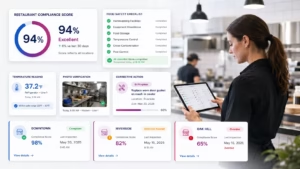
Taqtics helps restaurant, QSR, café, and food-service teams standardize execution across locations by connecting recurring tasks, checklists, SOPs, audits, issue resolution, training, assets, corrective actions, and operational reporting.
Instead of relying on scattered spreadsheets, calls, messages, and paper forms, teams can use one operating layer to assign work, capture proof, identify exceptions, route corrective action, and compare execution across outlets.
See Where Restaurant Operations Are Breaking Down Before They Affect the Guest
Connect tasks, audits, issues, training, assets, and operational reporting across every outlet with clear ownership and real-time visibility.
Conclusion
Improving restaurant operations is not about adding more procedures. It is about making critical work easier to execute consistently, making ownership clearer, identifying failures earlier, and ensuring corrective actions actually close the gap.
Start with the routines that have the greatest impact on food quality, food safety, service, equipment, staff performance, and customer experience. Standardize them, measure execution, review exceptions, and improve the process whenever the same problem repeats.
About the Author