Supermarket vs. Hypermarket: Key Differences and What’s Best for You
Supermarkets and hypermarkets both sell everyday essentials, but they serve different shopping missions.
A supermarket focuses mainly on groceries, fresh food, personal care, and household products. It is usually designed for convenient daily or weekly shopping.
A hypermarket combines a supermarket with a much broader general-merchandise offer. Customers may find groceries, clothing, electronics, appliances, home products, and other categories in the same location.
The difference affects more than store size. It changes product assortment, location, inventory complexity, staffing, pricing, customer flow, and day-to-day operations.
This guide compares supermarkets and hypermarkets from both a shopper and retail-operations perspective.
Supermarket vs. hypermarket: the quick answer
The simplest difference is focus versus scale.
A supermarket focuses on food and household essentials in a relatively compact format. A hypermarket combines groceries with large non-food departments and is built for broader, often less frequent shopping trips.
| Factor | Supermarket | Hypermarket |
|---|---|---|
| Primary focus | Groceries and household essentials | Groceries plus broad general merchandise |
| Store size | Medium to large | Very large |
| Typical location | Residential areas, city locations, neighborhood catchments | Suburban areas, retail parks, large commercial zones |
| Shopping mission | Daily or weekly essentials | Large, planned, one-stop shopping trips |
| Product range | Mainly food, fresh produce, FMCG, personal care, household items | Food plus clothing, electronics, appliances, home goods, toys, and more |
| Store layout | Compact aisles designed for speed and convenience | Large departments, wider spaces, longer customer journeys |
| Inventory complexity | High focus on fast-moving and perishable stock | Mix of fast-moving, slow-moving, seasonal, bulky, and non-food stock |
| Operating model | Frequent replenishment and fast checkout | Multi-department operations and larger-scale coordination |
What is a supermarket?
A supermarket is a self-service retail store focused mainly on food, groceries, fresh produce, beverages, personal care, and household essentials.
Common supermarket departments include:
- fresh fruit and vegetables;
- dairy;
- bakery;
- meat or seafood;
- frozen food;
- packaged groceries;
- beverages;
- cleaning products;
- personal care.
Supermarkets usually compete on convenience, availability, freshness, price, promotions, and checkout speed.
Customers often visit more frequently because the format is built around regular household needs.
What is a hypermarket?
A hypermarket is a very large retail format that combines supermarket categories with a broad range of general merchandise.
Alongside groceries, a hypermarket may sell:
- clothing;
- electronics;
- small and large appliances;
- home products;
- furniture;
- toys;
- sports products;
- seasonal merchandise.
Hypermarkets are designed as one-stop destinations. Customers can complete several shopping missions in one visit.
Because the format needs more space, parking, storage, and departments, hypermarkets are often located outside dense residential neighborhoods or in large retail destinations.
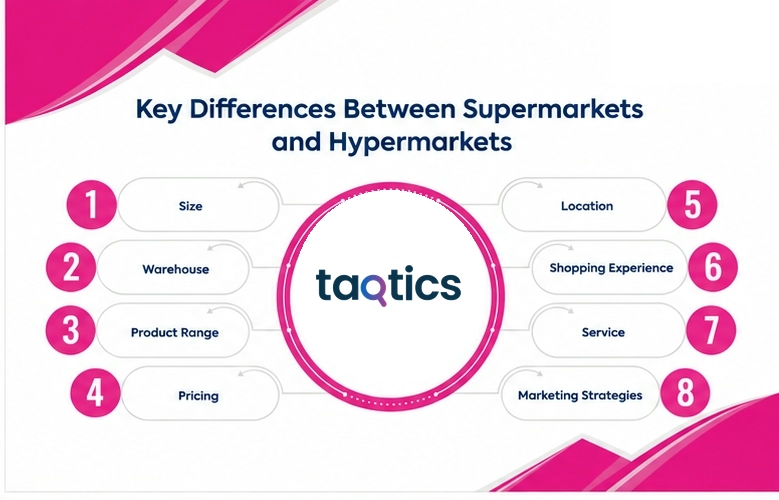
8 key differences between a supermarket and a hypermarket
1. Store size and layout
Supermarkets use a more compact layout built around efficient grocery shopping.
Hypermarkets need substantially more floor space because they combine food with multiple non-food departments.
The larger format also creates longer customer paths, more fixtures, more signage, and more operational zones.
2. Product assortment
Supermarkets concentrate on high-frequency household needs.
Hypermarkets carry those same categories but add a much wider range of discretionary and durable products.
This means a supermarket assortment usually has a stronger FMCG and fresh-food focus, while a hypermarket must manage very different product lifecycles in the same store.
3. Location
Supermarkets often succeed through proximity.
They are commonly located close to residential areas, offices, or urban catchments where customers can shop frequently.
Hypermarkets need larger sites and parking areas. They are more likely to operate as destination stores in suburban zones, retail parks, or large commercial developments.
4. Customer shopping mission
Supermarket visits tend to be shorter and more frequent.
Customers often visit for fresh food, weekly groceries, or household essentials.
Hypermarket visits are more likely to be planned around larger baskets, broader category needs, or bulk purchases.
5. Pricing and promotions
Both formats use promotions, loyalty programs, and competitive pricing.
Hypermarkets can place greater emphasis on volume, multipacks, and large-basket value because of their scale and broad assortment.
Supermarkets often compete more heavily on convenience, fresh-food value, weekly offers, and frequent-shopper promotions.
6. Inventory management
Supermarkets manage many fast-moving and perishable products.
That creates strong requirements around freshness, expiry, replenishment, stock rotation, and on-shelf availability.
Hypermarkets face those same grocery challenges plus slow-moving and bulky categories such as appliances, home products, fashion, and seasonal merchandise.
This makes inventory planning more complex across the larger format.
7. Staffing and department management
A supermarket may organize teams around fresh departments, checkout, replenishment, customer service, and store management.
A hypermarket needs additional category teams and department-level coordination because more product types and services operate under one roof.
Managers also need to coordinate more space, more assets, more employees, and more operational exceptions.
8. Customer experience
Supermarkets are designed around speed, familiarity, and convenient access to essentials.
Hypermarkets create a broader one-stop shopping experience. Customers may spend more time browsing and move through several departments during one visit.
Neither format is automatically better. Each serves a different customer need.
How supermarket and hypermarket operations differ
The operational model changes with the store format.
Supermarket operations
Supermarket teams often place greater daily emphasis on:
- freshness and expiry control;
- opening readiness;
- shelf replenishment;
- stock rotation;
- cleanliness;
- temperature controls;
- checkout speed;
- promotion execution;
- food and customer safety.
For multi-store grocery operations, Supermarket Management Software can help central teams standardize recurring store processes and improve visibility across locations.
Hypermarket operations
Hypermarkets need many of the same grocery routines, plus coordination across larger non-food departments.
Operational priorities may include:
- department-level task ownership;
- large-scale replenishment;
- multiple storage areas;
- promotion coordination across categories;
- asset and fixture management;
- visual merchandising;
- maintenance;
- larger staffing structures;
- more complex store audits.
For broader multi-location retail execution, Retail Management Software can help teams manage recurring operational standards across large-format locations.
Inventory and replenishment: why the formats need different controls
Inventory is one of the biggest operational differences between the two formats.
A supermarket needs tight control of fast-moving inventory and perishable products. Teams must replenish shelves quickly and remove expired or damaged stock before it reaches customers.
A hypermarket must manage those same processes while also controlling products with very different demand patterns, storage requirements, sizes, values, and replenishment cycles.
That difference affects:
- warehouse and backroom design;
- receiving;
- stock counting;
- replenishment frequency;
- department ownership;
- shrinkage controls;
- seasonal planning.
Do supermarkets and hypermarkets need different technology?
Both formats need reliable systems for sales, inventory, workforce, and store operations.
The required depth changes with scale.
A supermarket may prioritize:
- fast checkout;
- fresh-stock visibility;
- replenishment;
- food-safety routines;
- daily tasks;
- promotion execution.
A hypermarket may need those capabilities plus:
- multi-department coordination;
- larger asset registers;
- more complex inventory and warehouse workflows;
- department-level reporting;
- broader visual merchandising controls;
- larger workforce coordination.
Recurring store routines can be managed through Retail Task Management Software.
Formal store inspections can use Audit & Inspection Management Software when teams need scoring, evidence, findings, and corrective-action follow-up.
Supermarket or hypermarket: which is better for shoppers?
Choose based on the shopping mission.
Choose a supermarket when:
- you mainly need groceries or household essentials;
- you want a quicker shopping trip;
- proximity matters;
- you buy fresh food frequently;
- you prefer a more compact store.
Choose a hypermarket when:
- you need products from several categories in one trip;
- you are making a large or planned purchase;
- you want to compare a broader assortment;
- bulk packs or large-basket promotions matter;
- you are comfortable spending more time in the store.
Which format is better for a retail business?
The answer depends on the target market and operating model.
A supermarket format may fit when:
- the target customer shops frequently;
- the location has a strong residential catchment;
- food and FMCG make up the core assortment;
- convenience is a major competitive advantage;
- the business wants a more focused store footprint.
A hypermarket format may fit when:
- the business can support a large site;
- customers are willing to travel for one-stop shopping;
- the assortment spans many food and non-food categories;
- large baskets and broader choice support the value proposition;
- the business can manage higher operational complexity.
The right format should match customer demand, location economics, assortment strategy, capital requirements, supply chain capability, and management capacity.
How supermarkets and hypermarkets are changing

The line between physical and digital retail continues to narrow.
Both supermarkets and hypermarkets now need to support customer expectations beyond the traditional store visit.
Common changes include:
- online ordering;
- click-and-collect;
- home delivery;
- self-checkout;
- digital loyalty programs;
- electronic promotions;
- better inventory visibility;
- data-led store operations.
The core difference between the formats remains the same: supermarkets prioritize convenient grocery-led shopping, while hypermarkets offer a wider one-stop assortment at a much larger scale.
Supermarket vs. hypermarket FAQs
What is the main difference between a supermarket and a hypermarket?
A supermarket focuses mainly on groceries and household essentials. A hypermarket is much larger and combines groceries with broad general-merchandise categories such as clothing, electronics, appliances, and home products.
Which is bigger, a supermarket or a hypermarket?
A hypermarket is generally much larger than a supermarket because it includes multiple food and non-food departments under one roof.
Is a hypermarket the same as a supermarket?
No. Both are self-service retail formats, but a hypermarket has a much broader assortment and larger operating footprint.
What products are usually sold in a supermarket?
Supermarkets mainly sell groceries, fresh produce, dairy, bakery products, beverages, packaged food, personal care products, and household essentials.
What products are sold in a hypermarket?
Hypermarkets sell groceries and household essentials along with categories such as clothing, electronics, appliances, furniture, toys, home goods, and seasonal products.
Why are hypermarkets often located outside city centers?
Hypermarkets need large buildings, parking, storage, and access for high-volume operations. Large suburban or commercial sites often provide more suitable space.
Which format is better for weekly grocery shopping?
A supermarket is usually more convenient for regular grocery shopping because it focuses on food and household essentials and is often located closer to residential areas.
Are supermarkets easier to operate than hypermarkets?
Supermarkets generally have a narrower assortment and smaller footprint, but they still face complex fresh-food, replenishment, safety, and availability requirements. Hypermarkets add more departments, assets, inventory types, and coordination, which increases overall operational complexity.
Conclusion
The difference between a supermarket and a hypermarket comes down to scale, assortment, customer mission, and operating complexity.
Supermarkets focus on convenient, frequent shopping for groceries and household essentials.
Hypermarkets combine that grocery offer with many non-food categories to create a larger one-stop shopping destination.
For retailers, choosing between the two formats affects inventory, staffing, space, supply chain, technology, and daily execution.
For grocery-led multi-location operations, explore Taqtics Supermarket Management Software. For broader large-format retail operations, explore Taqtics Retail Management Software.
About the Author