Honest StoreForce Review (Data-Backed) 2026: Pros vs Cons, Features, Pricing
StoreForce review begins with a question most retail and hospitality leaders ask in 2026: Can workforce optimization software truly improve frontline performance without increasing operational complexity? StoreForce review evaluates this through real-world adoption data. The software supports thousands of frontline employees across retail and foodservice brands, helping organizations improve labor productivity, reduce compliance gaps, and increase sales per labor hour through smarter scheduling, task execution, and performance analytics.
StoreForce’s specialty retail analysis shows that aligning schedules to peak sales hours, something that the software enables through predictive planning, can help brands capture up to 50% of weekly sales during the top 20 open hours and achieve 2–4% sales uplift without increasing labor spend.
In this StoreForce review guide, we will discuss its core features, pros and cons, pricing structure, real-world performance insights, and whether StoreForce is the right fit for your frontline operations in 2026.
Our Honest Verdict
Average User Rating: 8/10
StoreForce is a cloud-based workforce and retail operations management platform designed to help specialty retailers optimize workforce scheduling, improve performance tracking, and enhance task execution. Users particularly appreciate its robust labor analytics, scheduling capabilities, and mobile access, while some note a learning curve with reporting and advanced features.
| Parameter | Rating (out of 10) |
| Overall Satisfaction | 8 |
| Ease of Use | 8 |
| Features & Functionality | 8 |
| Customer Support | 8 |
| Value for Money | 8 |
| Likelihood to Recommend | 8 |
Summary
StoreForce is a specialized workforce and retail operations management platform, built mainly for specialty retail businesses. It combines labor scheduling, time & attendance, performance analytics, task management, and employee engagement into one cloud-based SaaS solution aimed at helping retailers align staff with customer demand, improve operational consistency, and boost store performance.
The platform’s real-time dashboards, demand-driven scheduling, and performance insights make it suitable for multi-location retail environments where efficient workforce planning and execution are critical.
Key Features
StoreForce offers a comprehensive suite of tools that empower retailers with workforce optimization and execution capabilities:
- Advanced workforce scheduling & forecasting (predictive labor planning)
- Mobile access for schedules, task updates, and team communication
- Performance analytics with real-time KPIs and dashboards
- Task & execution management to standardize store processes
- Labor compliance & time tracking with automated timekeeping
- Employee engagement tools (goalboards, leaderboards, feedback)
- Integration with payroll/HR systems to automate data flows
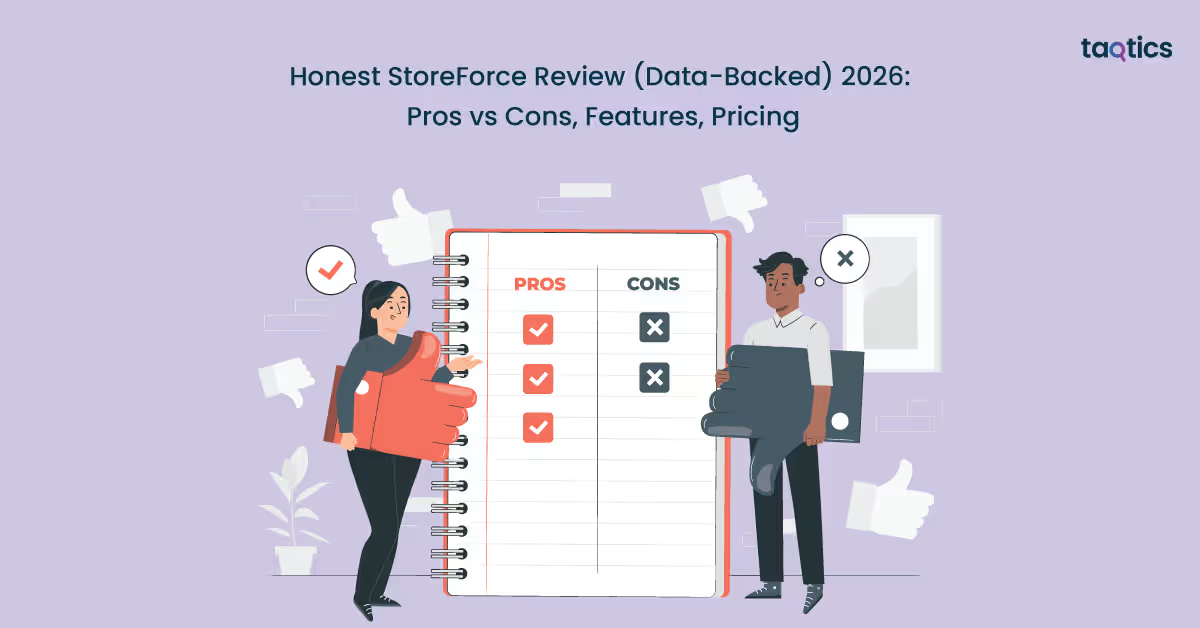
Pros & Cons
| Pros | Cons |
| Improves labor scheduling and workforce efficiency by aligning staffing with demand patterns. | Reporting tools have a learning curve, and customization can be limited. |
| Real-time analytics and KPIs help drive data-driven decisions. | Some users find certain scheduling adjustments and advanced reporting time-consuming to set up. |
| Mobile access supports communication and updates on the go. | Mobile app ratings suggest occasional performance issues. |
| Unified platform combines performance, scheduling, and task execution. | Initial onboarding and configuration may require training and change management. |
| Integrates with existing enterprise systems (payroll/HR) to reduce manual work. | No publicly listed pricing — requires contacting sales for details. |
What is StoreForce?
StoreForce is a cloud-based workforce and retail operations management platform built for specialty retailers. It helps businesses optimize labor planning, scheduling, task execution, and performance tracking through a single, integrated system. Unlike traditional workforce tools, StoreForce directly connects staffing decisions with sales performance and in-store execution, enabling retailers to deliver consistent customer experiences while improving productivity.
Founded in 2010 by retail industry experts, StoreForce was created to address a key gap in retail technology—workforce management systems that failed to reflect real store-level operational needs. From the outset, the platform focused on combining labor management with performance analytics, employee engagement, and execution tools, an approach formalized through its Workforce Management Plus (WFM+) model.
StoreForce expanded its feature set to include mobile employee self-service, real-time dashboards, goal tracking, and task management, while also growing its presence across global retail markets. In 2023, the company accelerated its expansion with strategic investment from Accel-KKR and enhanced its execution capabilities through the acquisition of ThinkTime. Today, StoreForce supports retailers worldwide in improving workforce efficiency and store-level performance.
StoreForce Company Details
- Company Type: Private
- Headquarters: Toronto, Ontario, Canada
- Year Founded: 2010
- CEO: Kurt von Koch
- Number of Employees: 51-200
- Number of Users: Over 250,000+ retail associates across 52 countries
- Company Description: StoreForce is a cloud-based retail workforce and operations platform that helps specialty retailers align staffing with customer demand, streamline store execution, and improve performance. It enables smarter scheduling, real-time performance visibility, task management, and employee engagement from one system. By connecting labor planning directly to sales outcomes and in-store execution, StoreForce helps retailers boost productivity, ensure consistency across locations, and deliver better customer experiences at scale.
What are StoreForce’s Review Ratings from Review Sites?
| Review Site | Rating |
| Capterra | 4.7/5
(13 reviews) |
| G2 | 3.8/5
(13 reviews) |
| GetApp | 4.7/5 |
| Aggregated User Sentiment (SelectHub) | ≈ 86 % recommend |
What are the Core Features of StoreForce?
The core features of StoreForce are workforce management, performance management, retail execution, and employee engagement.
Workforce Management
StoreForce helps retailers forecast demand and create optimized schedules so the right number of associates are available during peak and low-traffic hours. By aligning staffing with sales patterns, it reduces overstaffing, controls labor costs, and improves customer service on the floor.
The solution also includes time and attendance tracking and compliance support, helping managers reduce manual errors and administrative effort while maintaining accuracy across locations.
Verdict: 8.6/10
Performance Management
This feature gives retailers real-time visibility into KPIs such as sales, conversion, and productivity through intuitive dashboards. Managers can track performance at store, district, and employee levels, enabling faster decisions and more effective coaching.
By linking performance data with labor insights, StoreForce helps retailers understand what drives results and take corrective action quickly to improve outcomes.
Verdict: 8.4/10
Retail Execution (Task Management)
StoreForce ensures corporate strategies are executed consistently at the store level through structured task management. Headquarters can assign tasks, monitor completion, and validate execution across all locations.
This reduces operational gaps, improves accountability, and ensures brand standards are followed daily, even in large multi-store environments.
Verdict: 8/10
Employee Engagement
Employee engagement tools give associates access to schedules, shift changes, communications, and performance feedback through a mobile-friendly interface. This transparency improves morale and reduces scheduling friction.
Gamification elements such as leaderboards and goal tracking further motivate teams, helping retailers improve retention and frontline productivity.
Verdict: 8.2/10
StoreForce stands out as a purpose-built platform that helps specialty retailers connect labor planning, execution, and performance in one system. By improving visibility, consistency, and employee engagement, it enables retailers to run smarter stores and drive measurable results at scale.
What are the Use Cases of StoreForce?
Specialty Retail (Apparel, Footwear, Lifestyle Brands)
Inconsistent staffing during peak and non-peak hours leads to lost sales, higher labor costs, and uneven customer experiences.
How StoreForce Helps:
- Forecasts demand using sales and traffic patterns
- Creates optimized, demand-driven staff schedules
- Provides real-time performance dashboards for managers
Efficiency Gains:
- Improves sales per labor hour
- Reduces time spent on manual scheduling
- Ensures better coverage during high-conversion hours
Grocery & Convenience Stores
Thin margins and high footfall require precise staffing to avoid long queues or overstaffing.
How StoreForce Helps:
- Aligns labor schedules with peak shopping windows
- Tracks labor performance against store goals
- Supports task execution for restocking and promotions
Efficiency Gains:
- Lowers unnecessary labor costs
- Improves checkout speed and service levels
- Increases operational predictability during rush hours
Big-Box & Large-Format Retailers
Managing workforce needs across departments and locations is complex and time-consuming.
How StoreForce Helps:
- Centralizes labor planning and workforce visibility
- Enables store-to-store performance benchmarking
- Supports scalable scheduling across locations
Efficiency Gains:
- Reduces administrative workload for managers
- Improves consistency across large store networks
- Optimizes staffing across departments
Pharmacy & Regulated Retail
Compliance requirements and fluctuating demand make scheduling accuracy critical.
How StoreForce Helps:
- Automates compliant scheduling and time tracking
- Separates staffing needs for pharmacy vs retail zones
- Reduces manual compliance checks
Efficiency Gains:
- Minimizes compliance risks and scheduling errors
- Improves workforce utilization
- Frees managers from corrective admin tasks
Consumer Electronics & Specialty Tech Stores
Sales depend heavily on having skilled staff available during high-intent buying periods.
How StoreForce Helps:
- Schedules top performers during peak sales windows
- Links performance data with staffing decisions
- Provides insight into conversion and productivity
Efficiency Gains:
- Increases conversion rates
- Boosts sales per employee
- Improves customer experience during key moments
Franchise & Multi-Brand Retail Networks
Maintaining consistent execution and brand standards across locations is challenging.
How StoreForce Helps:
- Standardizes task execution across stores
- Tracks completion and accountability in real time
- Improves communication between HQ and stores
Efficiency Gains:
- Improves operational consistency
- Reduces execution errors
- Strengthens brand experience across locations
StoreForce’s Integration
StoreForce combines built-in connectors with custom API flexibility and professional setup support so retailers can sync operational data across systems securely and efficiently.
Built-In Integrations
- Supports pre-configured connections (e.g., traffic or POS system syncing) so key operational data flows into workforce planning automatically — such as syncing traffic data from systems like T.M.A.S. into StoreForce on a scheduled basis.
- Works with partner ecosystems to connect data sources that help with scheduling, forecasting, and performance analysis (via documented partner channels).
- Typical built-in setups reduce manual data import/export, enabling quicker setup for common retail workflows.
Custom Integration via API
- Offers API-based integration capabilities so retailers can build custom data flows between StoreForce and systems like HR/payroll, POS, or traffic/analytics tools.
- APIs allow automated workflows — for example, syncing store performance or scheduling info with external reporting or payroll systems.
- Developers can customize data exchange rules, synchronization frequency, and mapping logic to align with unique business needs.
Authenticity & Security
- Integration typically uses secure API keys and authenticated endpoints, ensuring only authorized systems exchange data.
- Retailers must map systems (like location identifiers) securely so data flows correctly and only between matched entities.
- Best practices include encrypted data transmission, access credentials management, and audit checks with support guidance for secure configuration.
Professional Support
- Implementation support from StoreForce teams helps plan, configure, and validate integrations before production use.
- Experts assist with API credential setup, field mapping, testing and troubleshooting, ensuring integrations are robust and aligned to retailer workflows.
- Ongoing help is available for maintenance, versioning updates, and refining integration behavior as needs evolve.
With these, StoreForce ensures integrations are done right and maintained effectively, enhancing automation and data accuracy across labor, performance, and execution functions.
StoreForce’s User Interface
StoreForce’s user interface (UI) is designed to be intuitive and data-driven, bringing complex retail operations into clear visual views for both desktop and mobile users.
How to Set Up
The setup process is typically guided by StoreForce’s implementation team with documentation and training support.
- Account & Access: After onboarding, users receive login credentials to the StoreForce cloud portal.
- Initial Configuration: Administrators define stores, roles, scheduling rules, performance targets, and labor forecasts to align with business needs.
- Data Sync: Store and employee data are imported from HR or POS systems (via integrations or file imports), ensuring schedules and analytics use accurate inputs.
- Customization: Dashboards and report filters can be tailored so users see relevant KPIs, hours, sales figures, and task lists.
Dashboard & Feature Exploration
- Visual Scheduling: Central scheduling screens show staff shifts against demand curves and traffic forecasts, using intuitive color blocks that represent coverage levels.
- Performance Dashboards: Metrics like sales, conversion rates, labor cost percentage, and other KPIs are displayed in bar and line charts for real-time performance tracking.
- Task & Execution Views: Users can view task checklists, completion status, and alerts directly from the interface.
- Mobile Interface: A simplified version presents tasks, schedules, and KPI summaries — ideal for store teams and field managers.
- Interactive Reports: Clickable charts and lists allow users to drill down into specific stores, time periods, or workforce groups for deeper insights.
Ease of Adoption
- Intuitive Design: The UI focuses on clarity with charts and visuals rather than raw tables, making it easier for store managers to interpret data fast.
- Training & Support: Guided onboarding, online help resources, and documentation support users during the adoption phase.
- Mobile Accessibility: Tablet and smartphone screens bring core functionality to frontline workers, reducing friction and helping staff engage directly with schedules and KPIs.
StoreForce’s interface blends powerful analytics and scheduling tools into approachable dashboards that are easy to navigate and adopt across teams, supported with guided setup and mobile access to ensure rapid user engagement.
How Secure is StoreForce?
StoreForce places a strong emphasis on protecting sensitive retail, employee, and operational data by leveraging modern cloud security practices and underlying platform safeguards. Robust security is especially important for workforce and retail execution systems that handle personal and business-critical information.
Security Measures
- Secure Cloud Infrastructure: StoreForce runs on cloud environments designed with industry-standard protections, including data encryption in transit and at rest, secure network architecture, and physically protected data centers.
- Authentication & Access Control: User access is controlled through secure login credentials, role-based permissions, and (where supported) additional controls such as multi-factor authentication to limit access to authorized users only.
- API & Integration Security: Integrations (e.g., for traffic data or HR systems) rely on API keys and secure credential exchange, ensuring partner systems can only interact with StoreForce data when appropriately authorized.
- Data Privacy Compliance: StoreForce’s safeguards support compliance with data protection expectations in regulated industries, protecting sensitive employee and operational records from unauthorized access or breaches.
- Security Best Practices Built In: By aligning with SaaS security best practices, including least-privilege access, session control, encrypted communications, and monitoring tools, StoreForce helps retailers maintain control and oversight.
Verdict – 8.5/10
StoreForce combines cloud security foundations, controlled access, encrypted data handling, and API protection to safeguard retailer data and support compliance, giving organizations confidence that workforce and performance data remain protected within a secure SaaS environment.
StoreForce Pricing Structure
1. Enterprise Plan (Core Subscription)
Target Audience:
- Large retail enterprises and multi-location specialty retailers
- Organizations needing full workforce planning, performance, and retail execution tools
Key Features (Quick Bullets):
- Automated labor forecasting & demand-driven scheduling
- Real-time performance dashboards and KPI tracking
- Task execution and consistency tools across store networks
- Mobile access for schedules, tasks & engagement
- Compliance and labor rule management
Support Offered:
- Email, phone, help desk, chat support
- Documentation and knowledge base
- Live training and webinars (varies by agreement)
Pricing:
- Starts at around CA$5,000 / month (~USD equivalent) as a base subscription.
- Annual or multi-year contracts are commonly used, with exact figures based on user count and modules included.
2. Custom & Negotiated Plans
Target Audience:
- Mid-size retailers or global enterprises with specialized deployment needs
- Organizations requiring tailored integration, dashboards, or support SLAs
Key Features (Quick Bullets):
- Optionally include custom reports and advanced analytics
- Additional integrations with POS, HR/Payroll systems (as part of implementation)
- Dedicated account management and onboarding support
- Region-specific language and compliance settings
Support Offered:
- Premium support packages with quicker SLAs
- On-site or dedicated training as part of onboarding
- Custom set-up assistance with data migration
Pricing:
- Quotes are customized based on organization size and requirements.
- Some market intelligence suggests pricing often reflects enterprise-level deals (e.g., average contract values over US$600,000 annually for large deployments).
Verdict – 7.8 / 10
StoreForce’s pricing approach is strong for mid‑to‑large retail enterprises that need deep workforce planning, performance analytics, and execution management. However, the lack of clear public pricing tiers and generally high entry costs can make budgeting and initial evaluation difficult for smaller businesses or organizations exploring options, contributing to a somewhat lower overall score.
How Easily You Can Implement StoreForce?
StoreForce is designed to streamline workforce management, scheduling, and retail execution for specialty retailers. While its intuitive interface and pre‑built workflows make adoption easier, a structured implementation approach ensures accurate setup, smooth integration, and faster ROI. Professional guidance is recommended to maximize efficiency and reduce errors.
Step-by-Step Implementation
- Kickoff & Planning
- Define business goals, KPIs, and the stores/teams involved.
- Map existing HR, payroll, POS, and labor processes.
- Core Configuration
- Set up stores, employee roles, labor rules, and compliance parameters.
- Configure scheduling templates, performance metrics, and task workflows.
- Data Import & Integration
- Import employee, store, and performance data.
- Connect traffic, sales, and HR systems using APIs or secure file transfers.
- Dashboard & Reporting Setup
- Customize dashboards for KPIs like sales, labor cost %, and task completion.
- Validate reports for accuracy and completeness.
- Testing & Validation
- Run trial schedules and tasks to ensure data integrity.
- Verify integrations and system alerts.
- Training & Onboarding
- Role-based training for managers and staff.
- Enable mobile access for schedules, tasks, and performance tracking.
- Go-Live & Monitoring
- Launch with support available.
- Refine scheduling rules and workflows based on first cycles.
Is Professional Support Required?
Yes. Professional support helps ensure integrations, configurations, and workflows are set up correctly, reducing errors and accelerating adoption. While the UI is intuitive, guidance ensures multi-store deployments run smoothly and efficiently.
When Professional Support Helps
- Mapping employee, store, and integration data accurately
- Configuring compliance rules and labor policies
- Customizing dashboards and KPIs for specific roles
- Training managers and employees for rapid adoption
- Validating schedules, task workflows, and reports before go-live
Verdict: 8.5/10
StoreForce offers an intuitive platform for retailers, but professional support significantly smoothens rollout and ensures integrations and workflows are accurate. With guided implementation, retailers can quickly achieve operational efficiency, consistent execution, and improved workforce productivity.
StoreForce Customer Support
You can reach StoreForce’s support team through multiple official channels anytime.
Email Support
- General/support inquiries: getintouch@storeforcesolutions.com (primary contact for sales, support, and product questions)
- App/technical support email in some app listings: support@storeforcesolutions.com
Office Phone Numbers (Depending on Region)
- North America: +1 416‑642‑7438
- UK / Europe: +44 12‑7392‑1800
- Australia: +61 438‑362‑438
- South Africa: +27 82‑9019034
Support / Contact Form
- Existing customers can submit support requests through the official Contact/Support form on the StoreForce website, which routes inquiries to the appropriate support team.
Average Turnaround Time (TAT) for Replies
Many enterprise platforms aim to acknowledge initial support requests within 2–4 business hours during business days. Full resolution times, however, can vary based on ticket type and priority level, simple questions are often resolved faster, while integrations and technical issues take longer.
Since StoreForce serves retail enterprises across time zones, actual response times may depend on your region and support tier agreed upon in your contract.
Verdict – 8.5/10
StoreForce is a robust and intuitive workforce management platform that delivers significant efficiency, performance tracking, and retail execution benefits. Its professional support, secure integrations, and feature-rich dashboard make it a strong choice for specialty and multi-location retailers.
What are the Advantages of Using StoreForce?
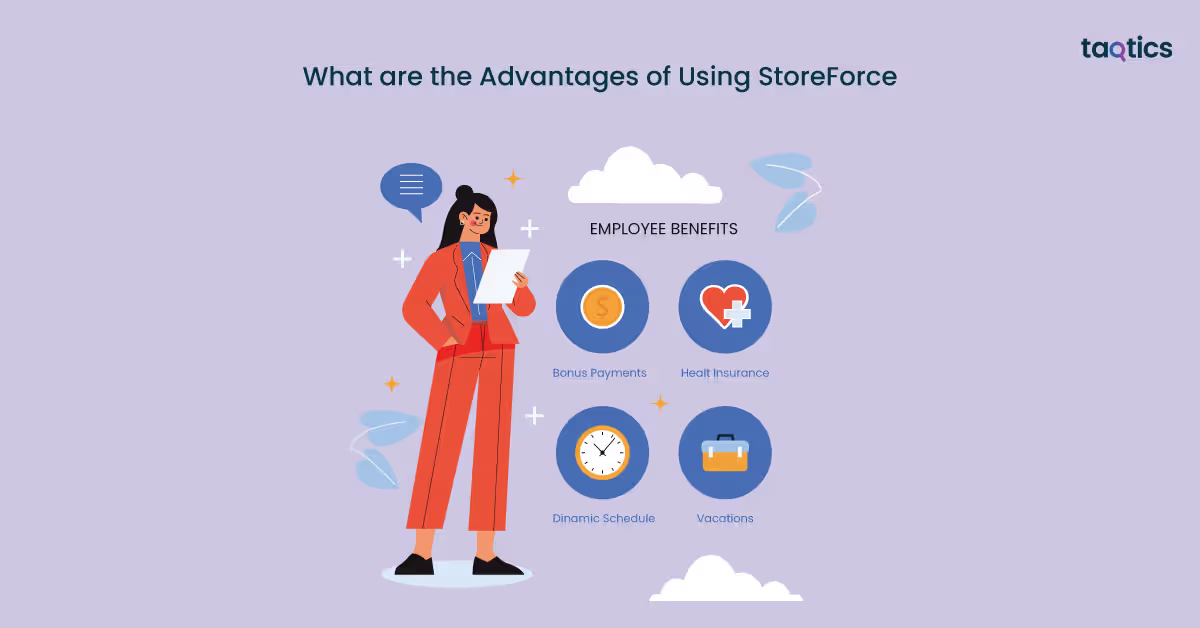
The advantages of using StoreForce lie in its ability to streamline workforce management, improve retail execution, and provide real-time insights, all tailored specifically for specialty and multi-location retailers.
- Demand‑Driven Workforce Optimization: StoreForce uses historical sales and traffic data to forecast labor needs, helping retailers schedule the right number of staff at the right times. This reduces overstaffing, avoids understaffing during peak hours, and improves customer service quality.
- Unified Scheduling and Labor Management: Rather than juggling spreadsheets or disparate systems, StoreForce provides centralized scheduling, time and attendance tracking, and labor compliance in one platform. This simplifies workforce planning and reduces administrative workload.
- Real‑Time Performance Visibility: Managers get dynamic dashboards and KPI tracking that show labor costs, sales performance, conversion rates, and other key metrics in real time. This supports faster, data‑driven decisions and better performance outcomes.
- Enhanced Retail Execution: With built‑in task and execution management, corporate directives and store processes are standardized and tracked for completion. This helps ensure operational consistency and accountability across all locations.
- Improved Employee Engagement: Employees can access schedules, request shift swaps, check tasks, and receive feedback through the mobile interface. This boosts transparency, morale, and engagement, leading to higher retention and productivity.
- Mobile Accessibility: StoreForce’s mobile app empowers store teams and managers to view schedules, tasks, and KPIs on the go, enabling decision‑making and task execution anywhere without being tied to a desktop.
- Flexible Integration Capabilities: The platform integrates with external systems like HR/payroll, traffic analytics, and POS tools via APIs or file feeds, ensuring accurate data flows and streamlined workflows between systems.
- Retail‑Focused Design: Unlike generic workforce tools, StoreForce is built specifically for retail operational challenges, meaning its features reflect real use cases like peak‑hour demand, in‑store execution, and store performance metrics.
- Scalability for Multi‑Location Retailers: Whether a retailer operates dozens or hundreds of locations, StoreForce’s centralized controls and analytics easily scale, keeping consistency, compliance, and visibility across regions.
- Strong Security & Compliance: With secure cloud infrastructure, role‑based access controls, and encrypted data handling, StoreForce helps protect sensitive workforce and operational data while supporting compliance requirements.
StoreForce helps retailers optimize labor, improve execution, engage employees, and make better decisions, all from one unified platform, leading to lower costs, higher productivity, and more consistent store performance.
What are the Limitations of Using StoreForce?
The limitations of using StoreForce primarily relate to its enterprise focus, pricing, and setup requirements, which may not suit all types of retailers.
- High Cost for Smaller Retailers: StoreForce is designed for medium to large retail chains, which means the pricing structure can be prohibitive for smaller businesses. Annual subscriptions and customized quotes often reflect enterprise-level budgets, making it difficult for smaller retailers to justify the investment. For companies with fewer locations or limited workforce management complexity, the cost-to-value ratio may be less favorable compared to simpler tools.
- Implementation Complexity: Although StoreForce has an intuitive interface, the platform’s full setup, including integrations, labor rules, and dashboard configuration, can be complex. Retailers often require professional support to ensure proper implementation. Without guided assistance, there’s a risk of misconfigurations that could affect scheduling accuracy, performance tracking, and reporting. This adds both time and cost to the onboarding process.
- Limited Public Pricing Transparency: StoreForce does not provide publicly available pricing tiers, requiring prospective customers to contact sales for customized quotes. This lack of transparency can make it difficult for smaller retailers or budget-conscious organizations to plan and evaluate the software before engaging with the sales team.
- Learning Curve for New Users: While the user interface is visually intuitive, managers and store associates may still need training to effectively leverage dashboards, scheduling tools, and mobile features. In multi-location deployments, ensuring consistent adoption across all stores can be challenging and requires structured onboarding and support.
- Dependence on Internet Connectivity: Being a cloud-based platform, StoreForce requires stable internet connectivity to access schedules, tasks, and performance data in real time. Stores with unreliable or slow internet may experience delays in syncing data, which can affect task execution and reporting.
- Limited Customization Without API Work: StoreForce’s built-in features cover most standard retail workflows, but advanced customization or integrations beyond pre-configured options require API setup and technical support. Retailers without in-house IT resources may find it challenging to implement custom workflows or connect additional systems, limiting flexibility for unique operational needs.
While StoreForce delivers powerful tools for workforce and retail management, its limitations, high cost, implementation complexity, reliance on professional support, and need for stable connectivity, make it most suitable for medium to large retail operations rather than smaller businesses.
What Customers are Saying about StoreForce?
What Users Like
- Intuitive & Useful Scheduling & Analytics – Users find that StoreForce helps them efficiently plan staff schedules based on sales and traffic data, improving workforce management.
- One Platform for Workforce & Task Management – Customers appreciate having scheduling, task management, and reporting all in a single platform, which reduces the need for multiple tools.
- Strong Customer Support & Training – Many users highlight that onboarding and ongoing support from the StoreForce team is timely, helpful, and responsive.
- Ease of Use & Adoption – The intuitive dashboards and mobile access make it easy for store teams and managers to quickly learn and adopt the platform.
What Users Disliked
- Scheduling Rigidity & Flexibility Issues – Some users feel that the automated scheduling can be too rigid, making it difficult to adapt to unexpected changes in staffing needs.
- Reporting Limitations – Customers mention that creating custom reports can be less flexible and more time-consuming than they would like.
- Learning Curve with Advanced Features – While basic functions are easy to use, some users note that understanding detailed performance metrics and dashboards requires additional training.
- Interface & Performance Issues – A few users report occasional slow loading times or minor glitches in the user interface, which can affect workflow.
Top StoreForce Alternatives
| Alternative | Target Audience | Key Strengths | Ease of Use & Support | Pricing |
| Taqtics | Multi‑location retail & restaurants | • Digital SOP checklists & automation
• Store audits, compliance & VM execution • Issue ticketing & real‑time resolution • Attendance & training tools |
Designed with frontline operators in mind — simple UI, real‑time dashboards, mobile support & strong onboarding | Starts ~ $4-5/user/mo with scalable plans; demo available free trial |
| Reflexis ONE | Large retail, hospitality & enterprise | • Workforce scheduling & optimization
• Task & store ops management • Real‑time insights & alerts |
Enterprise‑grade but more complex to configure and adopt | Custom enterprise pricing |
| Agendrix | Small to mid‑size retail & hospitality | • Shift scheduling & swaps
• Time & attendance tracking • Team messaging |
Simple and friendly UI, good for basic workforce needs; scheduling focused | ~ CAD $2.95/mo per user |
| QuickBooks Time | General workforce time & attendance | • GPS tracking & kiosk clock‑in
• Integrated time & shift planning |
Easy for basic tracking but not tailored for retail ops | ~ USD $20/mo per user |
| Clockify | All‑size teams needing time tracking | • Unlimited time tracking
• Offline sync & reports |
Very basic feature set; limited retail‑specific capabilities | ~ USD $3.99/mo per user |
Is Taqtics the Best Alternative to StoreForce?
Yes, Taqtics is the best alternative to StoreForce as it focuses on real‑world retail and restaurant operations execution with tools designed to ensure consistent in‑store compliance, task execution, and operational visibility, which are areas where traditional workforce systems like StoreForce don’t emphasize as deeply.
Taqtics goes beyond workforce planning to digitize SOP checklists, audits, issue tracking, merchandising compliance, training, and asset management in one platform, giving stores practical tools to run daily operations efficiently and consistently.
Unique Features of Taqtics
- Digital SOP & Task Checklists: Scheduled, customizable checklists with real‑time tracking ensure every store follows standards accurately each day.
- Real‑Time Compliance & Dashboards: Headquarters get live insights into task completion, store compliance, and outstanding issues across all locations.
- AI‑Powered Visual Merchandising: Photos submitted by store teams can be automatically reviewed and flagged for brand guideline mismatches.
- Centralized Issue Management: Automated ticketing with escalation workflows speeds issue resolution and reduces delays.
- Geo‑Fenced Attendance & Training Management: GPS‑verified check‑ins and on‑demand training improve accuracy and employee readiness.
Verdict – 8.3/10
Taqtics earns a strong 8.3/10 as a StoreForce alternative because it prioritizes frontline execution, compliance, and operational consistency with features that help retailers and restaurants run better stores every day. Its focus on practical task management and real‑time insights makes it especially valuable for brands looking to improve execution and compliance without heavy workforce analytics overhead.
About the Author